


Types of T-Shirt Fabrics: Your Full Buying Guide
TL;DR:
- Understanding t-shirt fabrics is crucial for making durable, comfortable, and suitable clothing choices. Cotton, especially ring-spun combed, remains the most popular for breathability and softness, while performance fabrics like polyester excel in moisture-wicking and durability. Fabric weight, construction, and fiber content all significantly influence fit, feel, and longevity, guiding smarter purchases and wardrobe building.
Walk into any clothing store or browse any apparel site and you will find dozens of t-shirts that look nearly identical on the hanger. The real differences live in the fabric. Understanding the types of t-shirt fabrics separates a smart purchase from a disappointing one. Whether you want something that lasts years of heavy wear, prints cleanly, breathes in summer heat, or feels luxurious against your skin, the fabric is where that story starts. This guide breaks down every major option with the specifics you need to choose well.
Table of Contents
- Key takeaways
- 1. Understanding the criteria for choosing t-shirt fabrics
- 2. Cotton: the most popular t-shirt fabric
- 3. Polyester: the performance fabric
- 4. Cotton-polyester blends
- 5. Tri-blends: the premium soft option
- 6. Modal: the luxury everyday fabric
- 7. Bamboo fabric
- 8. Linen
- 9. Spandex blends
- 10. Fabric weight categories compared
- 11. Side-by-side fabric comparison
- My honest take on fabric choices
- Build your wardrobe on fabric that actually lasts
- FAQ
Key takeaways
| Point | Details |
|---|---|
| Cotton dominates for a reason | 100% cotton remains the most breathable and comfortable everyday fabric, weighing between 120 and 180 GSM. |
| Fabric construction matters as much as fiber | Ring-spun combed cotton feels softer and lasts longer than carded cotton because short fibers are removed during production. |
| Weight determines climate suitability | Lightweight fabrics (135 to 150 GSM) suit warm weather; heavyweight options (230 to 270 GSM) offer more warmth and structure. |
| Printability depends on fiber content | 100% cotton absorbs ink best for DTG printing, while polyester is required for sublimation techniques. |
| Sustainability is about longevity too | The most eco-friendly t-shirt is often the one built to last, not just the one made from organic fiber. |
1. Understanding the criteria for choosing t-shirt fabrics
Before getting into specific fabric types, you need a framework. Fabrics do not exist in a vacuum. They perform differently depending on how you use them, where you wear them, and what you expect from them.
The first factor is fabric weight, measured in grams per square meter (GSM) or ounces per square yard. Weight tells you how thick and substantial a fabric feels. It also affects warmth, drape, and durability. A 160 GSM shirt feels noticeably different from a 280 GSM shirt, even if both are 100% cotton.
The second factor people often miss: fiber content and fabric construction are not the same thing. Fiber content tells you what the yarn is made of. Construction tells you how that yarn was spun and knitted. Fabric knit and yarn quality determine drape and smoothness far more than fiber content alone.
Other key criteria include:
- Breathability: How well the fabric allows air to circulate against your skin
- Durability: How the fabric holds up through repeated washing and wearing
- Printability: Whether the fabric accepts ink from DTG, screen, or sublimation printing
- Sustainability: Whether the fiber source and production process minimize environmental impact
- Cost: How fiber type, yarn quality, and finishing affect the price per unit
Pro Tip: When comparing two t-shirts with the same fiber content, ask about the yarn spinning method. Ring-spun cotton always outperforms open-end carded cotton in softness and print clarity.
2. Cotton: the most popular t-shirt fabric
Cotton is where most people start, and for good reason. It is breathable, soft, widely available, and easy to care for. But not all cotton is created equal, and knowing the differences will change how you shop.
100% carded cotton is the most basic form. The fibers are combed in one direction but short fibers remain in the yarn. This creates a slightly rougher texture. Budget t-shirts typically use this construction.
Ring-spun combed cotton removes the short fibers entirely before spinning, producing a finer, smoother yarn. The result is a softer, more durable fabric that holds its shape better over time. Most premium cotton tees are ring-spun combed.
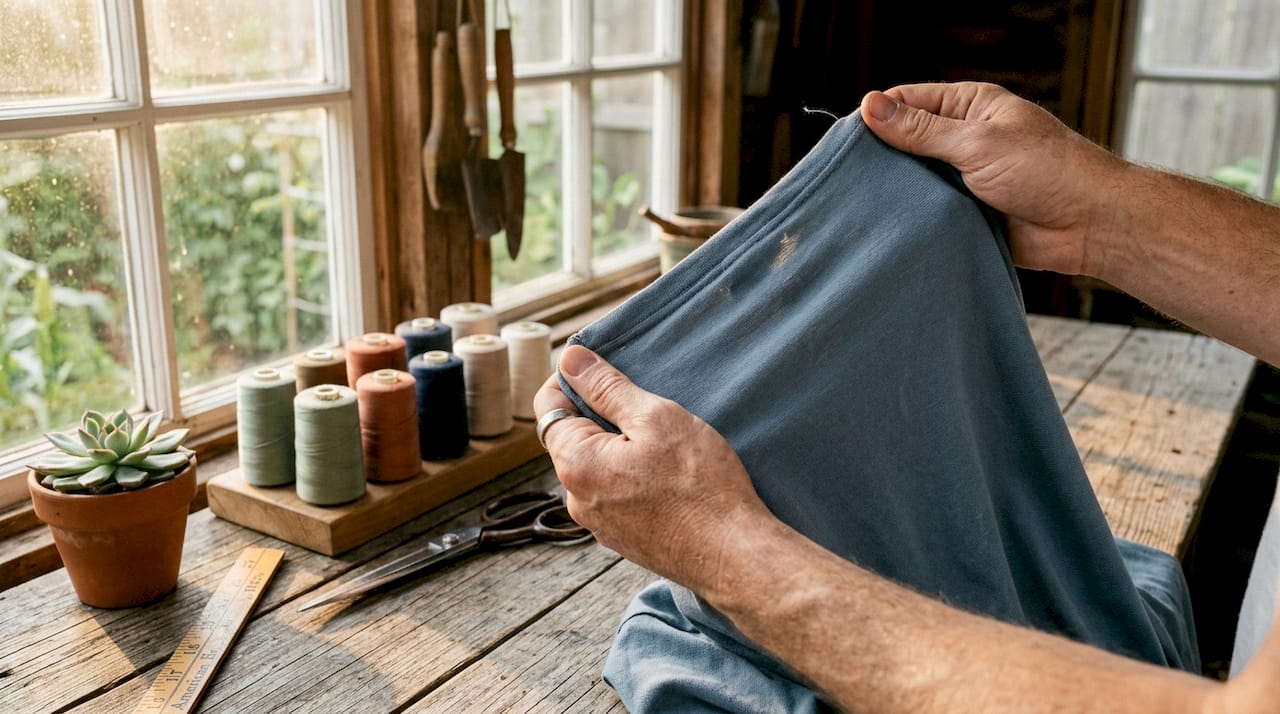
Organic cotton is grown without synthetic pesticides or fertilizers. It performs identically to conventional cotton in terms of feel and durability but carries a lower environmental cost. Look for GOTS certification to confirm authenticity.
Key pros and cons of 100% cotton:
- Pros: Natural breathability, absorbs moisture, excellent for DTG printing, hypoallergenic, easy to dye
- Cons: Prone to shrinking in high heat, slower to dry than synthetics, heavier when wet
Cotton works best for everyday casual wear, workwear basics, and any t-shirt intended for detailed print work. If you are exploring the full range of cotton for t-shirts, the variety within cotton alone is worth its own research.
3. Polyester: the performance fabric
Polyester is a synthetic fiber made from petroleum-based polymers. It is not as naturally breathable as cotton, but it offers a different set of advantages that make it the go-to choice for athletic and performance wear.
Polyester wicks moisture away from the skin rather than absorbing it. This keeps you cooler during physical activity because sweat moves to the fabric surface and evaporates quickly. It also dries far faster than cotton. Durability is another strength. Polyester fibers resist stretching and shrinking and hold color well through repeated washing.
The trade-off is comfort in everyday settings. Polyester can feel plasticky or clingy against skin, especially in humid conditions. It also traps odors more readily than natural fibers. For print work, sublimation printing requires polyester fibers since the ink bonds with synthetic material. DTG printing, on the other hand, does not adhere well to polyester.
Recycled polyester, made from plastic bottles, has become a strong sustainable option for brands looking to reduce virgin plastic use without sacrificing performance.
4. Cotton-polyester blends
Blends are where practical reality meets everyday preference. A 50/50 cotton-polyester blend takes the breathability and softness of cotton and combines it with the durability and shape retention of polyester. The result is a fabric that shrinks less than pure cotton, dries faster, and resists wrinkles.
CVC (Chief Value Cotton) blends typically run 60% cotton and 40% polyester. The higher cotton content means the fabric feels more like cotton while still benefiting from polyester stability. CVC is a popular choice for branded merchandise and everyday basics.
Blends print reasonably well with screen printing, though DTG results depend on the cotton percentage. The higher the cotton content, the better the ink absorption.
5. Tri-blends: the premium soft option
Tri-blend fabrics add a third fiber to the mix: rayon. The standard ratio is 50% polyester, 25% cotton, and 25% rayon. This combination produces a fabric that feels noticeably softer and lighter than a standard cotton-polyester blend.
Rayon is a semi-synthetic fiber derived from wood pulp. It drapes beautifully, feels silky against the skin, and adds a slightly vintage, worn-in look that many shoppers actively seek. Tri-blend shirts have a distinctive heathered appearance because the three fibers take dye differently.
The downside is that tri-blends can be more delicate. They require gentler washing, and print quality on DTG can be inconsistent because of the mixed fiber content. Screen printing works better on tri-blends than inkjet-based methods.
6. Modal: the luxury everyday fabric
Modal is a type of rayon made specifically from beech tree pulp. It is smoother than cotton, extremely soft, and holds color exceptionally well. Modal blends are used in premium t-shirts and loungewear where comfort is the primary goal.
What sets modal apart is its behavior when wet. Unlike cotton, it does not cling uncomfortably when damp. It also resists pilling better than standard rayon. The environmental footprint of modal depends heavily on how the beech trees are sourced and whether closed-loop production methods are used.
Modal is rarely used at 100% in t-shirts. It is most often blended with cotton (typically 50/50) to add softness while maintaining structure.
7. Bamboo fabric
Bamboo fabric occupies an interesting space in the market. Bamboo is one of the fastest-growing plants on earth, requires no pesticides, and regenerates without replanting. The environmental story is appealing.
The fabric itself is soft, moisture-wicking, and naturally antibacterial. It regulates temperature well, making it comfortable in both warm and cool conditions. Bamboo fabric also resists odors more effectively than cotton or polyester.
The catch: most bamboo fabric undergoes significant chemical processing to become wearable fiber, which reduces its environmental advantage. Look for bamboo labeled as “bamboo linen” (mechanically processed) rather than “bamboo viscose” (chemically processed) if sustainability is your priority. For a deeper look at eco-conscious fabric options, the sustainable fabric guide at Smokedtimes covers this territory well.
8. Linen
Linen is made from the flax plant and is one of the oldest fibers in human history. It is exceptionally breathable, stronger than cotton when wet, and becomes softer with each wash.
In t-shirts, linen works best in hot, dry climates. It does not hold shape as well as cotton or polyester, and it wrinkles easily. The casual, slightly textured look appeals to customers who prefer a natural, relaxed aesthetic. It is rarely used in high-volume commercial t-shirts but appears frequently in premium and artisan apparel.
9. Spandex blends
Spandex (also called elastane or Lycra) is almost never used on its own in t-shirts. It appears in small percentages, typically 2% to 5%, blended with cotton or polyester to add stretch and recovery.
A cotton-spandex blend gives you the comfort of cotton with four-way stretch that bounces back to shape. This is valuable for fitted t-shirts, athletic wear, and any garment that needs to move with the body without bagging out over time. The stretch also reduces the chance of seam stress during active use.
10. Fabric weight categories compared
Fabric weight directly affects how a t-shirt looks, feels, and performs. Here is a practical breakdown:
| Category | GSM Range | Best For |
|---|---|---|
| Lightweight | 135 to 150 GSM | Hot weather, layering, soft drape |
| Midweight | 170 to 200 GSM | Everyday wear, balanced print quality |
| Heavyweight | 230 to 270 GSM | Cold weather, structured look, durability |
Midweight sits at the industry sweet spot for most everyday use. It balances softness with enough body to hold a print cleanly and drape well without being stiff.
Pro Tip: Modal blends can feel lighter but actually be denser than cotton at the same GSM, so do not rely on GSM alone when comparing different fiber types.
Heavyweight cotton tees in the 230 to 270 GSM range offer exceptional warmth and structure but feel overbuilt in summer heat. Choosing the wrong weight for your climate is one of the most common and avoidable mistakes buyers make.
11. Side-by-side fabric comparison
| Fabric | Softness | Durability | Breathability | Eco Score | Printability | Price Range |
|---|---|---|---|---|---|---|
| 100% Cotton | High | Medium | High | Medium | Excellent | $ |
| Polyester | Low | High | Low | Low | Good (sublimation) | $ |
| Cotton-Poly Blend | Medium | High | Medium | Medium | Good | $ |
| Tri-Blend | Very High | Medium | Medium | Medium | Fair | $$ |
| Modal Blend | Very High | Medium | Medium | Medium | Fair | $$ |
| Bamboo | High | Medium | High | High | Fair | $$ |
| Linen | Medium | High | Very High | High | Poor | $$$ |
| Cotton-Spandex | High | High | High | Medium | Good | $$ |
For casual everyday wear, 100% cotton consistently rates highest on comfort and print performance. Athletic use favors polyester and performance blends. Premium fashion and luxury basics lean toward modal, tri-blend, and bamboo options.
My honest take on fabric choices
I have spent years looking at how fabric decisions play out in real wardrobes, and I keep seeing the same mistake: people focus entirely on fiber content and ignore construction quality. You can buy a 100% combed ring-spun cotton shirt that feels incredible, and you can buy another 100% cotton shirt that feels like sandpaper. The label reads the same. The experience is completely different.
What I have found actually matters: yarn spinning method, GSM, and seam construction. These are the details most product listings skip. A ring-spun combed yarn is not just a marketing claim. It is a measurably different product with longer fibers, less pilling, and better print uptake.
I also want to push back on the idea that sustainable fabric always means organic cotton. The garment that lasts five years of regular washing is often more sustainable than the “eco” shirt that pills and fades after ten washes. Construction quality and durability are environmental choices too.
My advice: do not buy based on fiber content alone. Ask about GSM, yarn method, and whether the fabric was tested for print compatibility before making a decision. The t-shirt that serves you longest is usually the smartest buy.
— Denis
Build your wardrobe on fabric that actually lasts
If this breakdown clarified what you are looking for in a t-shirt, Smokedtimes has done the work of sourcing fabrics that match these criteria. The focus at Smokedtimes is on heavyweight cotton basics built for repeat wear, with minimal branding and durable construction that holds up season after season.
Whether you are after a thick everyday tee, a vintage-feel essential, or want to understand how printing affects fabric longevity, Smokedtimes has the product range and editorial resources to point you in the right direction. Explore the full collection at smokedtimes.com and find the fabric weight and fiber combination that fits your actual lifestyle.
FAQ
What is the softest t-shirt fabric?
Modal blends and tri-blends (50% polyester, 25% cotton, 25% rayon) are consistently the softest t-shirt fabrics. Ring-spun combed cotton is the softest 100% natural option.
What is the most durable t-shirt material?
Polyester and cotton-polyester blends rank highest for durability. They resist stretching, shrinking, and color fading through repeated washing better than pure natural fibers.
Which fabric is best for hot weather?
Linen and lightweight bamboo fabric offer the best breathability for hot climates, followed by lightweight 100% cotton in the 135 to 150 GSM range.
Does fabric type affect how well a t-shirt prints?
Yes. 100% cotton absorbs ink best for direct-to-garment printing, while polyester is required for sublimation. Mixed-fiber fabrics can produce inconsistent print results depending on the cotton percentage.
What GSM is best for an everyday t-shirt?
Midweight fabrics in the 170 to 200 GSM range are the standard for everyday wear. This weight balances softness, structure, and print quality without feeling too heavy or too thin.