


Role of T-Shirts in Style: Versatility and Influence
Finding the perfect T-shirt often feels like a quest for authentic style and comfort. For young adults who crave versatility and trend-forward looks, these garments deliver more than convenience. The T-shirt’s evolution has shaped what it means to express cultural identity and personal flair in fashion, making it a powerful statement piece. Discover how the role of T-shirts in fashion continues to influence layering, individuality, and modern wardrobe choices.
Table of Contents
- Defining The Role Of T-Shirts In Fashion
- Major Types And Style Distinctions
- T-Shirts As Essential Layering Pieces
- Current Trends Shaping T-Shirt Fashion
- Common Style Mistakes And How To Avoid Them
Key Takeaways
| Point | Details |
|---|---|
| Cultural Significance of T-Shirts | T-shirts have evolved into powerful tools for personal and cultural expression, reflecting identity and social commentary. |
| Variety of Styles and Functions | Different T-shirt styles serve various purposes, from casual wear to athletic performance, highlighting the importance of fit and fabric. |
| Layering Essentials | T-shirts are versatile layering pieces that can enhance outfits across different settings and temperatures, making them fundamental to strategic dressing. |
| Common Styling Mistakes | Avoid typical errors such as incorrect sizing and poor fabric choices to ensure a polished appearance and boost confidence. |
Defining the Role of T-Shirts in Fashion
T-shirts have transcended their origins as basic undergarments to become powerful vehicles of personal and cultural expression. T-shirt’s evolution mirrors significant socio-political transformations, transforming from a simple clothing item into a complex cultural signifier that communicates individual identity and collective experience.
The cultural significance of t-shirts extends far beyond mere clothing. They serve multiple functions in contemporary fashion:
- Personal Branding: A canvas for self-expression
- Social Commentary: Platform for messaging and statements
- Generational Identity: Representing youth culture and trends
- Artistic Medium: Showcasing graphic design and creative expression
Historically, t-shirts emerged from utilitarian workwear, initially designed as comfortable undergarments for laborers and military personnel. Over decades, they transformed from backstage clothing to front-stage fashion statements. Youth subcultures played a critical role in this transition, adopting t-shirts as symbols of rebellion, music allegiance, and social movements.
T-shirts have become more than clothing - they are portable billboards of personal narrative and cultural discourse.
In modern fashion ecosystems, t-shirts represent democratized style - accessible, adaptable, and infinitely customizable. Whether plain, graphic-printed, or designer-branded, they communicate complex social signals about personality, affiliations, and aesthetic preferences.
Pro tip: Select t-shirts that genuinely reflect your personal style and make you feel confident, understanding they’re more than just fabric - they’re a form of self-expression.
Major Types and Style Distinctions
T-shirt design has evolved dramatically, offering a diverse range of styles that cater to different preferences, body types, and fashion sensibilities. Detailed market research highlights the complexity of T-shirt varieties, revealing nuanced distinctions that go beyond simple aesthetic choices.
The primary categories of T-shirts can be broadly classified into several key types:
- Classic Crew Neck: The standard, versatile design suitable for most occasions
- V-Neck: Provides a more elongated neckline, ideal for layering
- Henley Style: Features a placket with 2-4 buttons, offering a casual yet refined look
- Raglan Sleeve: Characterized by diagonal seams extending from the collar to the underarm
- Muscle Fit: Designed to accentuate muscular physiques with a tighter cut
Fabric composition plays a crucial role in defining T-shirt styles and performance. Modern T-shirts range from pure cotton classics to high-tech performance materials that offer moisture-wicking, temperature regulation, and enhanced durability.
Here’s a quick comparison of the main T-shirt neck and sleeve styles and their ideal uses:
| Style Type | Key Feature | Best Use Case |
|---|---|---|
| Crew Neck | Round neckline, classic fit | Everyday casualwear |
| V-Neck | Angled neckline for layering | Layering under shirts, jackets |
| Henley | Buttons at neck, collarless | Smart-casual, relaxed outfits |
| Raglan Sleeve | Seam from collar to underarm | Sporty or athletic occasions |
| Muscle Fit | Close-fitting, accentuates body | Showcasing physique, gym style |
Style is not just about appearance, but about how a garment makes you feel and performs.
Beyond basic design, contemporary T-shirts are distinguished by their specialized functions. Athletic performance shirts, sustainable eco-friendly options, and tech-integrated smart fabrics represent the cutting edge of T-shirt innovation. These variations reflect changing consumer demands for functionality, comfort, and environmental consciousness.
Pro tip: When selecting a T-shirt, consider not just style, but how the fabric and cut complement your body type and intended use.
T-Shirts as Essential Layering Pieces
Men’s T-shirts represent a fundamental building block in versatile fashion, offering unprecedented flexibility across different style contexts and temperature ranges. These adaptable garments serve as the cornerstone of smart, strategic dressing, enabling wearers to create multiple outfit combinations with minimal wardrobe pieces.
Layering strategies for T-shirts encompass several key approaches:
- Base Layer: Thin, form-fitting T-shirts that provide thermal regulation
- Mid-Layer: Slightly thicker T-shirts for added warmth and style
- Accent Layer: Contrasting color or textured T-shirts that add visual interest
- Performance Layer: Technical fabrics designed for specific environmental conditions
- Transitional Layer: Versatile pieces that bridge casual and semi-formal aesthetics
Fabric selection dramatically impacts a T-shirt’s layering potential. Cotton provides breathability, while synthetic blends offer moisture-wicking properties and enhanced durability. Advanced materials like merino wool and performance synthetics have revolutionized how individuals approach layered dressing.
This table summarizes common T-shirt fabric choices and their core advantages for layering:
| Fabric Type | Breathability | Durability | Ideal Layering Role |
|---|---|---|---|
| Cotton | High | Moderate | Base or accent |
| Polyester Blend | Moderate | High | Performance |
| Merino Wool | Excellent | Good | Base, thermal layer |
| Bamboo | Very high | Moderate | Summer layering |
Effective layering transforms a simple T-shirt from a basic garment into a style statement.
Contemporary fashion increasingly recognizes T-shirts as sophisticated layering tools. From slim-fit versions ideal for under blazers to oversized styles perfect for creating dimensional looks, these garments transcend their original utilitarian purpose. Role of layering in fashion has evolved to celebrate T-shirts as intelligent, adaptable fashion elements that reflect personal style and functional needs.
Pro tip: Invest in high-quality, neutral-toned T-shirts that can seamlessly integrate into multiple outfit compositions and layering scenarios.
Current Trends Shaping T-Shirt Fashion
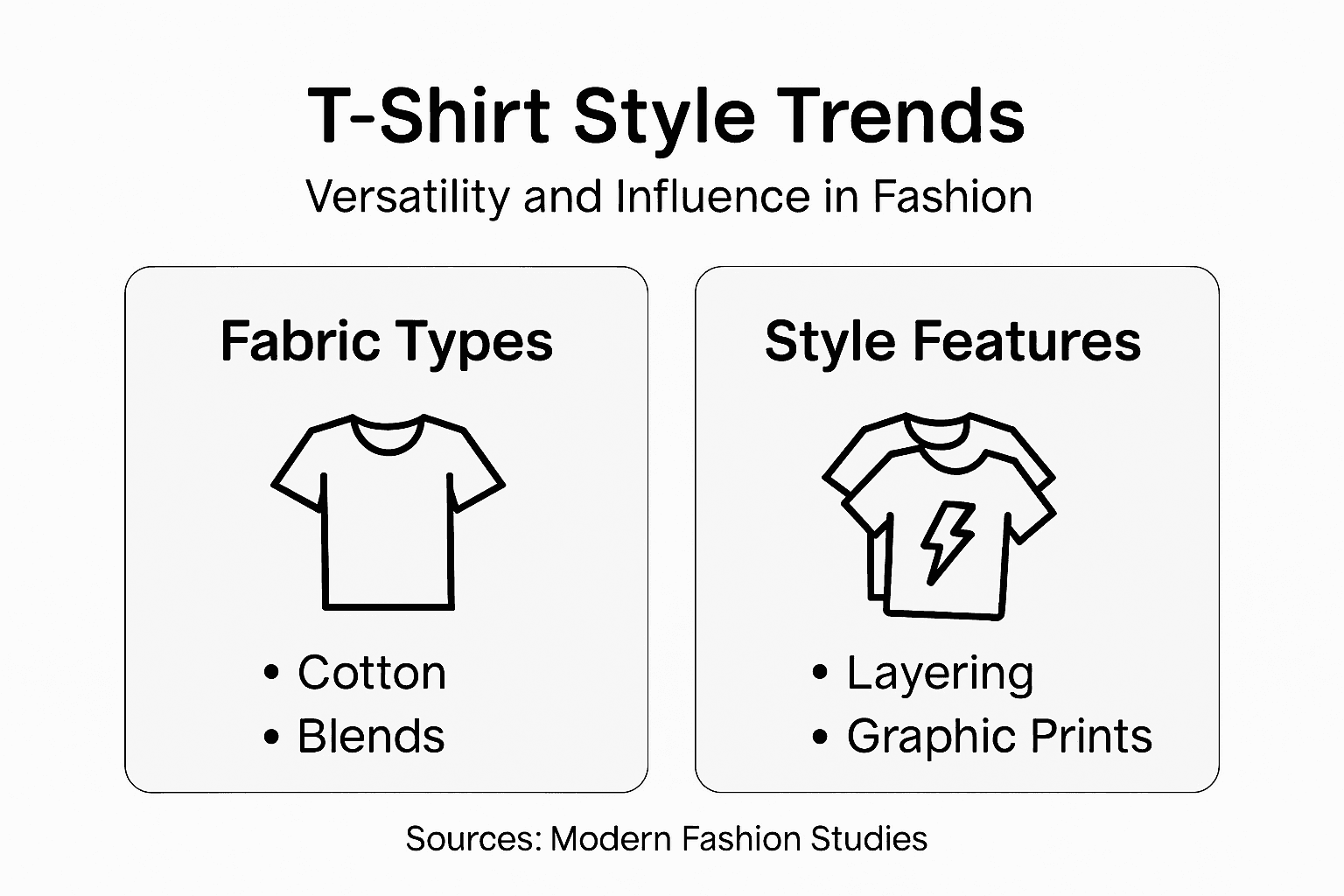
Graphic T-shirts have emerged as powerful creative outlets, transforming from simple clothing items into dynamic platforms for personal expression and social commentary. Modern T-shirt design reflects a complex intersection of fashion, technology, and cultural messaging that goes far beyond traditional aesthetic considerations.
Key contemporary T-shirt trends include:
- Sustainable Materials: Eco-friendly fabrics and production processes
- Bold Graphic Designs: Artistic prints with social and political statements
- Personalization Technologies: Custom digital printing and on-demand manufacturing
- Minimalist Aesthetics: Clean, understated designs with sophisticated appeal
- Performance Innovations: Technical fabrics with advanced functional properties
Digital influence has dramatically reshaped T-shirt fashion, with social media driving apparel trends at unprecedented speeds. Social platforms enable instant trend dissemination, allowing designers and consumers to collaborate and co-create fashion narratives in real-time.
Contemporary T-shirt design represents a dynamic dialogue between individual creativity and collective cultural expression.
The convergence of technology, sustainability, and personal storytelling has transformed T-shirts from basic wardrobe staples into nuanced cultural artifacts. Emerging designers are increasingly using T-shirts as canvases for artistic experimentation, social activism, and personal branding, challenging traditional fashion boundaries.
Pro tip: Select T-shirts that authentically represent your personal style and values, understanding that modern fashion is about meaningful self-expression.
Common Style Mistakes and How to Avoid Them
Men’s T-shirt style errors frequently stem from overlooking fundamental fit and context principles, creating fashion missteps that can undermine personal appearance and confidence. Understanding these common pitfalls is crucial for developing a sophisticated, adaptable wardrobe strategy.
Top T-shirt style mistakes to avoid include:
- Incorrect Sizing: Wearing shirts that are too tight or excessively loose
- Poor Color Coordination: Clashing colors that disrupt outfit harmony
- Inappropriate Fabric Selection: Using performance materials in formal settings
- Neglecting Fabric Quality: Choosing cheap, thin materials that quickly deteriorate
- Mismatched Occasion Styling: Wearing casual T-shirts in professional environments
Fit considerations represent the most critical aspect of T-shirt selection. Comprehensive fashion guides recommend understanding your body type and choosing shirts that complement your physique without appearing overly restrictive or baggy.
Style is about confidence, not perfection - choose T-shirts that make you feel comfortable and authentic.
Effective T-shirt styling requires nuanced understanding of layering, color theory, and personal body proportions. Strategic choices involving fabric weight, neckline depth, and sleeve length can dramatically enhance overall outfit presentation and personal aesthetic.
Pro tip: Invest in a few high-quality, well-fitted T-shirts in neutral colors that can be easily mixed and matched across multiple outfit configurations.
Elevate Your Style with Versatile T-Shirts from Smoked Times
The article highlights how T-shirts have transformed into essential style building blocks that combine comfort, adaptability, and personal expression. If you want to master the art of layering and showcase your individuality through clean, well-fitting basics, explore our Men’s Cotton T-Shirts – Clean Basics, No Prints collection. These T-shirts perfectly blend simplicity and quality, making them ideal for everyday wear or as foundational pieces in sophisticated outfits.
Don’t miss the chance to refresh your wardrobe with versatile T-shirts that reflect your style and confidence. Visit smokedtimes.com today to discover premium options crafted for lasting comfort and effortless layering. Start building your essential closet now with selections from our Cotton T-Shirts – Smoked Times and Essentials – Smoked Times categories. Experience the perfect balance of style and function delivered right to your doorstep.
Frequently Asked Questions
What is the significance of T-shirts in contemporary fashion?
T-shirts serve as powerful vehicles for personal and cultural expression, representing individual identity and collective experiences. They have become a canvas for self-expression and social commentary, reflecting trends, artistic styles, and generational identities.
How do I choose the right T-shirt type for layering?
When selecting a T-shirt for layering, consider the fabric and cut that best complements your body type and intended style. Options like crew necks work well as base layers, while muscle fits can showcase physique. Cotton is breathable, while performance fabrics add moisture-wicking functionality.
What are some common mistakes to avoid when wearing T-shirts?
Common mistakes include incorrect sizing (too tight or too loose), poor color coordination, using the wrong fabric for the occasion, neglecting fabric quality, and mismatching the T-shirt style with the setting or dress code. Choosing well-fitted, quality fabrics in neutral colors can enhance your overall look.
How have T-shirts evolved as a fashion statement?
T-shirts have evolved from basic workwear to versatile fashion staples, especially embraced by youth subcultures. They are now used to make bold style statements, convey social messages, and offer personalization options, showcasing the interplay between fashion, technology, and individual creativity.