


Shop seasonal sales smart: build your casual wardrobe wisely
TL;DR:
- Understand seasonal sale cycles to plan shopping around peak discounts and selection quality.
- Conduct closet audits to identify needs first and prioritize versatile, high-cost-per-wear basics.
- Recognize retail tactics and focus on quality and maintenance to maximize wardrobe longevity.
Shop seasonal sales smart: build your casual wardrobe wisely
You know the feeling. The sale banner is screaming 60% off, the cart fills fast, and the checkout rush feels like winning. Then February hits, and half those pieces are still on the hanger with their tags on. Trendy clearance finds that seemed irresistible in the moment rarely earn their space in a real wardrobe. The good news is that shopping seasonal sales strategically is a learnable skill, not a personality trait. This guide walks you through exactly how to time your shopping, prep with purpose, pick the right pieces, and sidestep the tricks that turn savings into waste.
Table of Contents
- Understand seasonal sale cycles and markdown timing
- Prepare: Audit your closet and build a needs-first game plan
- Shop smarter: Prioritize versatile staples and know what to skip
- Protect your savings: Spot deal traps and boost garment value
- Our take: Smarter sale shopping means owning your style, not just chasing deals
- Build your essential wardrobe with Smoked Times
- Frequently asked questions
Key Takeaways
| Point | Details |
|---|---|
| Shop at the right time | Maximize savings by targeting predictable sale windows, not random promotions. |
| Always make a plan | A needs-based list prevents impulse buys and helps build a more useful wardrobe. |
| Prioritize versatility | Choose casual basics and wardrobe anchors that mix and match for maximum wear. |
| Verify the deal and quality | Look beyond flashy discounts to avoid retail traps and ensure your savings last. |
Understand seasonal sale cycles and markdown timing
Smart sale shopping starts before you ever open a browser or walk into a store. It starts with knowing when retailers actually discount and why. Fashion retail runs on a fairly predictable seasonal rhythm, and once you understand it, you can plan around it rather than react to it.
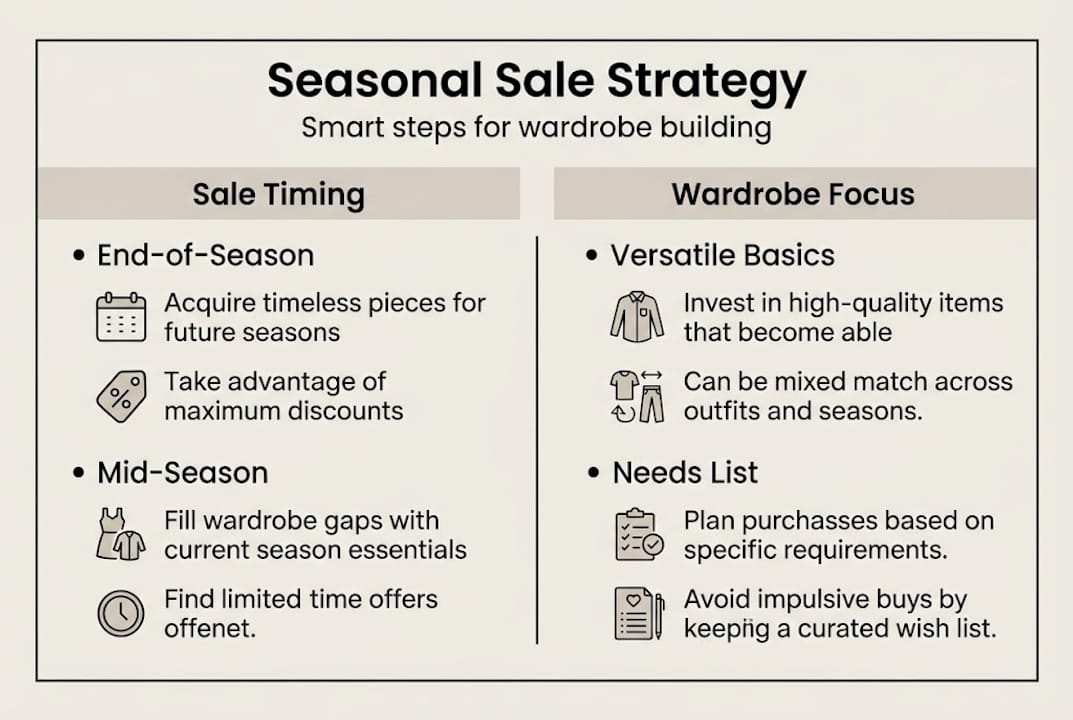
Most apparel brands operate on two main clearance cycles: end-of-summer (typically July through August) and end-of-winter (January through February). On top of those, major shopping events like Black Friday, Labor Day weekend, and post-holiday clearance sales in late December to early January create additional windows. Knowing these windows in advance means you are not caught off guard by a flash promo and scrambling to spend money you did not plan to spend.
Here is a quick reference for typical seasonal sale windows:
| Sale window | Timing | Discount depth | Selection quality |
|---|---|---|---|
| Mid-season markdowns | 4-6 weeks into season | 20-30% | Excellent |
| End-of-season clearance | Last 2-4 weeks of season | 40-70% | Limited |
| Post-holiday clearance | Late December to mid-January | 50-70% | Moderate |
| Holiday weekends (Labor Day, etc.) | Varies by retailer | 25-40% | Good |
| Flash/promo sales | Unpredictable | 15-40% | Varies |
The tradeoff between timing and selection is real. The seasonal discount strategies that deliver the deepest savings tend to show up later in the clearance cycle, but by then, popular sizes and colors are long gone. Going in earlier means paying a little more, but you actually get what fits you and works with your existing clothes.
This is why building an annual “markdown calendar” is one of the most practical moves you can make. Rather than chasing random promos, shop predictable clearance windows like end-of-season and post-holiday events. Block these dates in your calendar a month ahead and start thinking about what you actually need. Understanding seasonality in clothing also helps you predict which categories will go on deepest discount and when, so you are not guessing.
The deeper truth about markdowns is that bigger end-of-season discounts almost always come with higher selection risk. That 70% off hoodie is a steal if it is your size and your style. If it is neither, it is just clutter with a low price tag attached.
Pro Tip: Set a recurring calendar reminder two weeks before each major clearance window. Use that lead time to check your closet and build your shopping list. Arriving prepared means you make faster, smarter decisions when the sale goes live.
Prepare: Audit your closet and build a needs-first game plan
Knowing when to shop is only half the equation. Knowing what you actually need is where most people stumble, and it is the step that separates smart shoppers from impulsive ones. A closet audit before each sale season takes less than an hour and can save you hundreds of dollars in purchases you will never use.
Here is a practical step-by-step approach to auditing before you shop:
- Pull everything out. Take everything out of your closet and drawers and lay it flat. This is not about minimalism. It is about visibility. You cannot assess what you have if it is stuffed behind other things.
- Sort by frequency of wear. Make three piles: worn regularly, worn occasionally, and rarely or never worn. That third pile is data. It tells you what kind of pieces you consistently skip, so you do not buy more of them.
- Check for gaps, not just desires. Note what is worn out, what is missing from key categories (everyday basics, layering pieces, cold-weather options), and what you reach for but do not own. These are your real needs.
- Separate wants from needs clearly. Write both lists. Wants are fine, but they come second. Your shopping budget should cover needs first, and then revisit wants if budget allows.
- Rate versatility. For each item in your “want” column, ask how many outfits it works with in your current closet. If the answer is fewer than three, it probably does not belong on a priority list.
- Write your final list before you start browsing. A physical or digital list is a commitment device. It is much harder to throw off-list items into your cart when you have a written plan staring back at you.
This kind of structured approach to building a seasonal wardrobe turns sale shopping from a reactive event into a proactive one. It also makes you genuinely faster at shopping because you already know what you are looking for.
The evidence supports this method. Making shopping a repeatable process, with a closet audit and a prioritized list of needs versus wants, is one of the most reliable ways to avoid impulse purchases during sales. Impulsive buying during sales is not a willpower issue. It is a preparation issue.
For younger shoppers still figuring out their personal style, reading through wardrobe tips for young adults can help clarify which foundational pieces deserve to be at the top of any needs list.
Pro Tip: After your audit, photograph the gaps in your wardrobe and save those images to your phone. When you are browsing a sale and tempted by something off-list, pull up the photos first. If the item does not fill one of those visible gaps, skip it.
Shop smarter: Prioritize versatile staples and know what to skip
With a clear list in hand, the next challenge is staying disciplined inside the sale itself. Every retailer is designed to pull your attention toward what they want to move, not necessarily what you need. Knowing how to filter the noise is what makes the difference between a great haul and a cart full of regret.
The concept that guides smart sale buying is cost-per-wear, a value metric that divides the price of a garment by the estimated number of times you will actually wear it. A $90 heavyweight cotton hoodie you wear three times a week for three years costs you about ten cents per wear. A $20 trendy jacket you wear twice costs you $10 per wear. Cost-per-wear reframes the entire idea of a deal.
Building toward a capsule wardrobe for winter or any season means favoring pieces that act as anchors, items that pair easily with multiple other things you already own. These are the pieces worth paying attention to during a sale, even if the discount is modest.
Here is a comparison of how to think about different item types during sales:
| Item type | When to buy on sale | When to skip | Why |
|---|---|---|---|
| Core basics (tees, hoodies, pants) | Anytime, even mid-season markdown | Never, if quality is solid | High cost-per-wear, always needed |
| Classic outerwear | End-of-season clearance | If sizing or selection is gone | Long lifespan, justifies the wait |
| Statement pieces | Only if already on needs list | If trend-driven or occasion-specific | Low versatility, high risk of regret |
| Trend items | Almost never | Especially deep clearance | Short style lifespan, poor value |
According to Forbes’ capsule wardrobe guide, building a timeless, versatile wardrobe means prioritizing versatile anchors and only buying what genuinely pairs with what you already own. That standard applies double during a sale, when temptation is high and thinking time feels short.
Knowing what to skip during sales is just as important as knowing what to grab. A few quick criteria to help you decide:
- Skip it if it only works with one other item you own.
- Skip it if the fit is not already right. Sales are not a reason to compromise on fit.
- Skip it if it is heavily branded or logo-heavy and that is not your style.
- Skip it if you cannot name three occasions you would wear it in the next month.
- Skip it if it is on the sale rack because it is out of style, not out of season.
For inspiration on combining seasonal clothing trends with timeless basics, it helps to look at how anchors function across different outfit combinations before you commit to buying.
Protect your savings: Spot deal traps and boost garment value
Even with a solid plan and the right priorities, retailers have tools designed to get you to spend more than you intended. Recognizing these tactics is not about distrust. It is about staying in control of your own shopping decisions.
Some of the most common misleading sale practices include:
- Artificial inflation before markdown. A retailer raises the “original” price before the sale, so the discount looks bigger than it is. Always check third-party price tracking tools if you are making a large purchase.
- “Up to X% off” banners. That number applies to one or two items, often already sold out. Most of the range sits at a much smaller discount.
- Fine-print exclusions. The banner says 40% off, but the items you want are labeled “exclusions apply.” Always scroll to the terms before getting excited.
- Urgency pressure. Countdown timers and “only 2 left” labels are often engineered to trigger fast decisions. Slow down deliberately when you see them.
Retailers have a long history of using misleading discount framing. Always verify that the sale price is a genuine reduction before committing. Dodgy sales tactics are worth understanding so you can identify misleading discounts before they cost you.
Beyond spotting bad deals, protecting the value of good ones is about quality and care. Before you buy, run through this quick check:
- Check the stitching at seams and stress points. Loose threads or uneven stitching are signs of poor construction.
- Feel the fabric weight. Lightweight, thin materials pill and wear out faster, especially in basics you plan to wear repeatedly.
- Check for pilling on display items. If the floor sample is already pilling, the garment will not hold up long.
- Read the care label. Dry-clean only basics are not practical basics. Easy-wash fabrics survive real life better.
Once you have bought well, maintaining your pieces extends their life significantly. Washing in cold water, turning garments inside out, air-drying when possible, and storing knits folded instead of hung all add months or even years to a garment’s lifespan. Extending garment usability through maintenance is genuinely one of the highest-return habits a casual wardrobe builder can develop.

Want to master seasonal trends without constantly replacing your wardrobe? Prioritize durability at purchase and maintenance afterward. That combination stretches your clothing budget further than any sale percentage ever will.
Our take: Smarter sale shopping means owning your style, not just chasing deals
Here is an uncomfortable truth about sale shopping: the biggest discount is not always the best deal for your closet. We have seen it play out time and again. Someone spends $200 during a clearance event and walks away feeling like they saved $400, but six months later, most of those pieces are unworn. The math on savings only works if you actually use what you bought.
The real value of a sale is not the percentage off the sticker price. It is the opportunity to fill genuine gaps in your wardrobe with well-made pieces at a lower cost than you would normally pay. That only happens when you show up with intention, not just enthusiasm.
Style anchors, the quiet, versatile basics that work across multiple contexts and seasons, outlast trends every time. A well-made heavyweight tee or a solid hoodie worn 200 times over three years will always outperform a flashy clearance item worn twice. That principle should guide every purchase decision during a sale.
Building toward a coherent wardrobe through seasonal wardrobe strategies is a long game, not a sprint. The best version of sale shopping is not reactive. It is intentional, planned, and always anchored in who you actually are and what you genuinely need.
Build your essential wardrobe with Smoked Times
If this guide reflects how you want to approach your wardrobe, Smoked Times was built with exactly that mindset. Every piece in our collection is designed to function as an anchor: clean, durable, minimal branding, and built to be worn again and again across seasons.
Our wardrobe essentials range covers the foundational categories that belong at the top of any needs list: heavyweight cotton tees, relaxed hoodies, versatile pants, and cold-weather basics that do not go out of style. If you have just used this guide to build your list, we would love to be part of your next smart shopping season. After a great find, we would love to hear about it too. Share your experience with us and help other shoppers make better choices.
Frequently asked questions
When is the best time to shop seasonal sales for clothing?
The best clearance windows fall at the end of each season and post-holiday, but shopping a few weeks earlier gives you better selection with discounts that are still meaningful.
How do I avoid buying trends I won’t wear during sales?
Stick to your written needs list and prioritize versatile anchors over trend items. If a piece only works with one outfit in your current closet, it does not belong in your cart.
What are common retail sale traps to watch out for?
Watch for misleading discount framing, including inflated original prices, “up to X% off” banners that apply to almost nothing, and urgency tactics like artificial countdown timers.
How can I make my sale purchases last longer?
Extending garment life starts at purchase by checking fabric weight and stitching quality, then continues with proper care like cold washing, air-drying, and correct storage.