


Build effortless winter casual outfits for men: comfort meets style
Cold weather has a way of making even confident dressers second-guess themselves. You want to look sharp, stay warm, and move freely without wearing three bulky layers that make you look like you’re headed to base camp. The good news: building a reliable winter casual wardrobe isn’t complicated once you know which fabrics actually work, how to layer without overheating, and which outfit formulas hold up across real-life situations. This guide breaks it all down so you can get dressed with confidence every cold morning.
Table of Contents
- Get set for winter: The must-have wardrobe basics
- How to layer: The three-layer system for warmth and style
- Building outfit formulas: Real-world winter combinations
- Troubleshooting: Solving common winter outfit challenges
- Style upgrades: Making winter casual outfits look effortless
- Ready to upgrade your winter casual essentials?
- Frequently asked questions
Key Takeaways
| Point | Details |
|---|---|
| Start with the right fabrics | Merino wool and synthetics beat cotton for warmth and moisture control all season. |
| Use the three-layer rule | Base, mid, and outer layers let you adapt to changing weather and activity for comfort and style. |
| Mix textures and neutrals | Sticking to earth tones and varied fabrics ensures every outfit pairs easily and looks sharp. |
| Solve for real-life issues | Plan for overheating, wet snow, and body type with fit-forward, breathable, smart layers. |
| Outfit formulas make life easy | Using tried-and-tested outfit combinations cuts decision-making and boosts everyday confidence. |
Get set for winter: The must-have wardrobe basics
Every solid winter wardrobe starts with the same six building blocks: a base layer, a mid-layer, outerwear, versatile bottoms, boots, and cold-weather accessories. Think of these as your toolkit. Once you have them, getting dressed becomes a matter of mixing and matching rather than starting from scratch every day.
Fabric choice is where most guys go wrong. Cotton feels comfortable at room temperature, but it absorbs sweat and holds moisture against your skin, which makes you colder faster. The best winter fabrics for men are merino wool (thermoregulating and odor-resistant), wool flannel and corduroy (insulating with great texture), and fleece or sherpa (high warmth-to-weight ratio). These materials manage moisture, trap heat efficiently, and hold up through repeated wear.
For bottoms, versatility is the priority. Here’s a quick breakdown of the best options:
- Flannel-lined jeans: Warm, casual, and look like regular jeans from the outside
- Corduroy pants: Textured, insulating, and stylish enough for most casual settings
- Wool chinos: Cleaner look with natural warmth, great for going from outdoors to indoors
- Dark denim: Works in mild cold when paired with a strong base layer
You can also check out these clothing essentials for winter to see how each piece fits into a complete cold-weather wardrobe. Style editors at Esquire also recommend building around a few quality staples rather than buying a lot of average pieces.
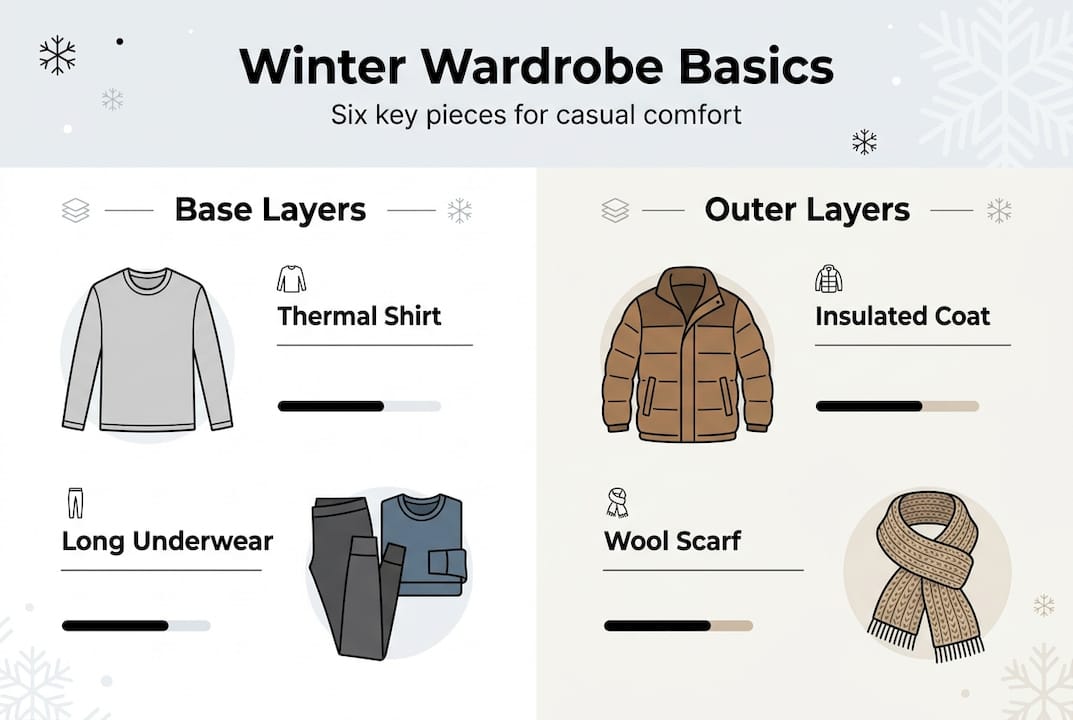
| Wardrobe piece | Best fabric | Key benefit |
|---|---|---|
| Base layer | Merino wool, synthetic blend | Moisture-wicking, odor-resistant |
| Mid-layer | Fleece, sherpa, heavy knit | High warmth-to-weight ratio |
| Outerwear | Wool, waxed cotton, down | Wind and cold protection |
| Bottoms | Corduroy, flannel-lined denim | Insulation with casual style |
| Boots | Leather, suede with lining | Warmth, grip, durability |
| Accessories | Wool, cashmere | Targeted warmth at extremities |
How to layer: The three-layer system for warmth and style
With your wardrobe stocked, let’s put those pieces together using a proven layering strategy. The three-layer system is the most reliable method for staying warm without overheating: a base layer wicks moisture away from your skin, a mid-layer traps heat, and an outer layer shields you from wind and cold.
Here’s how to apply it based on temperature:
- Mild cold (15-20°C / 59-68°F): Merino tee as base, light crewneck sweater as mid-layer, and a structured wool jacket or chore coat as outerwear
- Moderate cold (10-15°C / 50-59°F): Thermal base layer, medium-weight hoodie or fleece, and a heavier jacket like a waxed cotton or quilted coat
- Cold (0-10°C / 32-50°F): Fitted thermal or turtleneck, insulated sweater or sherpa fleece, and a full wool overcoat or down-filled jacket
- Freezing (below 0°C / 32°F): Heavyweight merino base, thick fleece or puffer mid-layer, and a long insulated coat with a scarf and gloves
The key principle here is thin to win. Fitted, non-bulky layers trap air more efficiently than one oversized piece. You also get the flexibility to remove a layer when you step inside. Explore more casual layering trends and the role of layering in building a functional wardrobe. For a broader look at winter layering methods, Observer’s guide covers a range of practical approaches.
| Layer | Purpose | Best fabrics | Avoid |
|---|---|---|---|
| Base | Moisture management | Merino wool, polyester | Cotton |
| Mid | Insulation | Fleece, sherpa, knit | Stiff, non-breathable synthetics |
| Outer | Wind and cold protection | Wool, waxed cotton, down | Thin, unlined shells |
Pro Tip: When shopping for a mid-layer, prioritize fit at the shoulders. If it’s too tight there, you’ll lose mobility and the layer won’t sit right under outerwear.
Building outfit formulas: Real-world winter combinations
Armed with layering know-how, it’s time to see how these principles work in real cold-weather outfit formulas. The goal isn’t to build a runway look. It’s to have three or four go-to combinations you can put together in under five minutes.
Here are three everyday formulas that actually work, based on tested winter outfits for men:
- The versatile daily: Merino tee + crewneck sweater + wool overcoat + dark jeans + Chelsea boots. This works for coffee runs, casual Fridays, and dinner out. The overcoat does the heavy lifting stylistically.
- The active cold day: Thermal base layer + hoodie + puffer jacket + corduroy pants + rugged boots. Built for days when you’re outside for extended periods. The hoodie adds a mid-layer buffer without adding stiffness.
- The outdoor casual: Flannel shirt + quilted vest + waxed jacket + chinos. The vest keeps your core warm while keeping your arms free. The waxed jacket handles light rain or snow without looking like rain gear.
Neutral colors are your best friend here. Navy, charcoal, camel, and earth tones mix freely across all three formulas, which means you can swap pieces without rebuilding the whole outfit. Check out how to build your winter look and mix and match winter style for more outfit ideas. You can also find solid layering outfit examples that translate well into winter.

Pro Tip: Build each outfit around one statement piece, whether that’s a textured overcoat or a bold-knit sweater, and keep everything else simple. One focal point is always more effective than three competing ones.
Troubleshooting: Solving common winter outfit challenges
Even with the right pieces and combinations, winter can throw you curveballs. Here’s how to troubleshoot the most common problems.
Overheating in transit is one of the most frustrating issues. You dress for the cold outside, then step into a heated office or subway car and start sweating through your base layer. The fix: choose outerwear with zip vents or pit zips, and always wear a moisture-wicking base. According to Men’s Health, using zip vents for overheating is one of the most practical solutions for managing body temperature in variable conditions.
Here are the most common winter outfit mistakes and how to fix them:
- Too much cotton: Replace cotton base layers with merino wool or a synthetic blend. Cotton holds sweat and chills you down fast.
- Over-layering: Three well-chosen layers beat five mediocre ones. More layers mean more bulk and less mobility.
- Ignoring breathability: A waterproof shell with no ventilation traps heat and moisture. Look for breathable membranes or zip vents.
- Wrong fit for slim builds: Fitted layers prevent the “marshmallow” effect. A structured coat over a slim thermal looks sharp, not shapeless.
“For wet snow days, choose synthetic insulation over down. Down loses its loft when wet and stops insulating effectively. Synthetics keep working even when damp.”
For a deeper look at the three-layer system for comfort and the winter comfort essentials that make it work, those resources break down the method in practical detail. Observer’s overcoming winter outfit problems guide also covers edge cases worth knowing.
Style upgrades: Making winter casual outfits look effortless
Once you’re comfortable and prepared, let’s take your winter casual look from basic to standout with a few insider style moves.
Start with your color palette. Neutral palettes like navy, charcoal, camel, and earth tones give you maximum versatility across casual settings. They mix without clashing, which means fewer decisions every morning. Once your base palette is set, use texture to add depth. A chunky knit sweater over a smooth merino base, or a waxed jacket over a soft flannel shirt, creates visual interest without adding color complexity.
Here are the style moves that make the biggest difference:
- Layer textures, not just warmth: Combine smooth, ribbed, and woven fabrics in one outfit for a more intentional look
- Fit over bulk: A slim-fit thermal under a relaxed mid-layer under a structured coat hits the right proportions for men aged 25-40
- Accessorize minimally but deliberately: A quality wool beanie or a leather-strap watch adds personality without overdoing it
- Match boot weight to outfit weight: Heavy rugged boots pair with casual layers; sleeker Chelsea boots work with cleaner, more structured outfits
Pro Tip: The most effortless winter outfits follow a simple proportion rule: fitted base, slightly relaxed mid-layer, and sharp outerwear. This creates a natural taper that looks intentional without trying too hard.
For more actionable ideas, browse our winter casual style tips and check out on-trend winter wear from Men’s Health for current inspiration.
Ready to upgrade your winter casual essentials?
You’ve got the framework. Now it’s about putting the right pieces in your closet. At Smoked Times, we build exactly the kind of wardrobe staples this guide is built around: clean, well-made basics that layer well, hold up through the season, and never go out of style.
Start with a foundation piece like our retro cotton t-shirts, made from organic Pima cotton for softness and durability. Layer it under our retro hoodie, an oversized mid-layer that hits the sweet spot between casual comfort and real warmth. Both pieces are designed to work together and with everything else in your rotation. If you’ve already tried our gear, we’d love to hear how it’s working for you. Head over and submit a review to share your experience or get outfit inspiration from the community.
Frequently asked questions
What fabrics keep you warm without overheating in winter?
Merino wool and synthetic blends are your best options. They wick moisture better than cotton, keeping you warm and dry even when you’re active.
Can I wear jeans in cold weather and stay comfortable?
Yes, absolutely. Flannel-lined jeans and corduroy are built for cold weather, and regular jeans work fine when paired with a thermal base layer underneath.
What’s the most effective layering method?
The three-layer system is the most reliable approach: a moisture-wicking base, an insulating mid-layer, and a protective outer layer that handles wind and cold.
How do slim men avoid looking bulky?
Stick to fitted layers to avoid bulk, like a slim thermal or turtleneck as your base, and choose outerwear with structure rather than oversized puffer jackets.
Are there quick tips for staying stylish but comfortable all winter?
Yes. Neutral palettes with texture contrast do most of the work. Focus on fit over volume, keep accessories minimal, and build outfits around one standout piece.