


Drop shipping fashion: how it works, risks, and rewards
TL;DR:
- Drop shipping in fashion shifts fulfillment risks but increases challenges in quality control and returns.
- Success depends on careful supplier vetting, accurate product descriptions, and managing customer expectations.
- Building strong supplier relationships and focusing on minimalist essentials enhance profitability and store sustainability.
Drop shipping fashion sounds like a dream setup: no warehouse, no bulk orders, no boxes piling up in your garage. But the entrepreneurs who actually make money with this model will tell you something different. Skipping inventory doesn’t mean skipping problems. It means swapping one set of problems for another. This guide breaks down exactly how fashion drop shipping works mechanically, where the real risks hide, and what it takes to build a store around timeless, minimalist apparel that generates repeat customers instead of repeat returns.
Table of Contents
- How drop shipping works in the fashion industry
- Key opportunities and limitations in drop shipping fashion
- Returns, fit, and customer expectations: the hidden risks
- What actually drives profitability in drop shipping fashion
- How to set up for success: practical steps for new fashion dropshippers
- The real secret to drop shipping fashion: relationships over tools
- Explore timeless drop shipping essentials with Smoked Times
- Frequently asked questions
Key Takeaways
| Point | Details |
|---|---|
| Drop shipping means no inventory | You run the storefront and the supplier packs and ships orders directly to the customer. |
| Returns and fit drive risk | Expect 20–30% return rates in fashion due to fit and quality, making returns management critical. |
| Margins are often thinner than they look | Marketing, shipping, platform fees, and returns reduce net profit far below listed markup. |
| Supplier selection is make-or-break | Reliable partners and clear product info are your best defense against customer disappointment. |
| Customer care is your domain | You’re responsible for customer service, reviews, and experience even though you never touch the product. |
How drop shipping works in the fashion industry
Before you build a single product page, you need to understand the flow of money, goods, and responsibility. Dropshipping fashion applies the standard dropshipping model to apparel: you run an online store, customers order from your site, and a third-party supplier ships directly to the buyer. You never touch the garment. You don’t pack boxes. You don’t manage warehouse space.
Here’s how the process works in order:
- A customer places an order on your storefront and pays your listed price.
- You forward the order (manually or via automation) to your supplier and pay their wholesale price.
- The supplier picks, packs, and ships the item directly to your customer.
- You pocket the difference between your retail price and the supplier’s cost, minus fees.
- You handle all customer communication before, during, and after delivery.
That last step is where many new dropshippers underestimate their workload. The seller’s core role is product selection, marketing, and coordination, while the supplier handles inventory, packaging, and shipping. This creates a critical trade-off: you gain freedom from fulfillment, but you lose direct control over the customer experience.
To see exactly what you manage versus what you hand off, compare the two models side by side:
| Responsibility | Drop shipping | Traditional ecommerce |
|---|---|---|
| Holding inventory | Supplier | You |
| Packing and shipping | Supplier | You |
| Product selection | You | You |
| Customer service | You | You |
| Quality control | Limited | Full |
| Upfront capital needed | Low | High |
| Margin control | Limited | Strong |
Understanding fashion e-commerce explained as a broader category helps you see where drop shipping sits within the landscape. It’s one model among several, and it fits certain business goals better than others.
Pro Tip: Before signing with any supplier, place a test order yourself. Pay for the full experience as a customer. Inspect packaging quality, shipping times, garment feel, and label presentation. What you see is exactly what your future customers will receive.
Key opportunities and limitations in drop shipping fashion
Now that you know each party’s responsibilities, you need to weigh whether the model’s real-world pros and cons match what you’re seeking as an entrepreneur.
The genuine upsides are real:
- Low startup cost. You don’t need to purchase stock upfront, which means you can launch with a fraction of the capital a traditional retailer needs.
- Flexible catalog. You can test dozens of products without financial risk tied to unsold inventory.
- No storage costs. No warehouse lease, no packing supplies, no staff to pick orders.
- Location independence. Your business runs wherever you have an internet connection.
But the limitations are just as real, and often ignored:
- Returns and fit issues hit harder in apparel than in almost any other category. Clothing is personal, tactile, and size-dependent.
- Less operational control means when a supplier ships the wrong item or uses slow shipping, you absorb the blame.
- Customer service burden. Every complaint, delay, and return flows through you, even though you didn’t cause the problem.
- Supplier dependency. If a supplier runs out of stock or raises prices, your business absorbs the impact immediately.
“Risk doesn’t disappear in drop shipping. It shifts. You trade inventory risk for fulfillment risk, quality risk, and relationship risk.”
For aspiring entrepreneurs selling fashion, including timeless and minimalist essentials, a major operational risk is returns, especially because clothing carries higher return rates driven by fit and quality expectations. Timeless styles help because you’re not chasing seasonal trends or selling fast-fashion pieces that fall apart after three washes. But even a well-made heavyweight cotton tee will generate returns if the sizing chart is vague or the product photo doesn’t reflect the true color and drape.
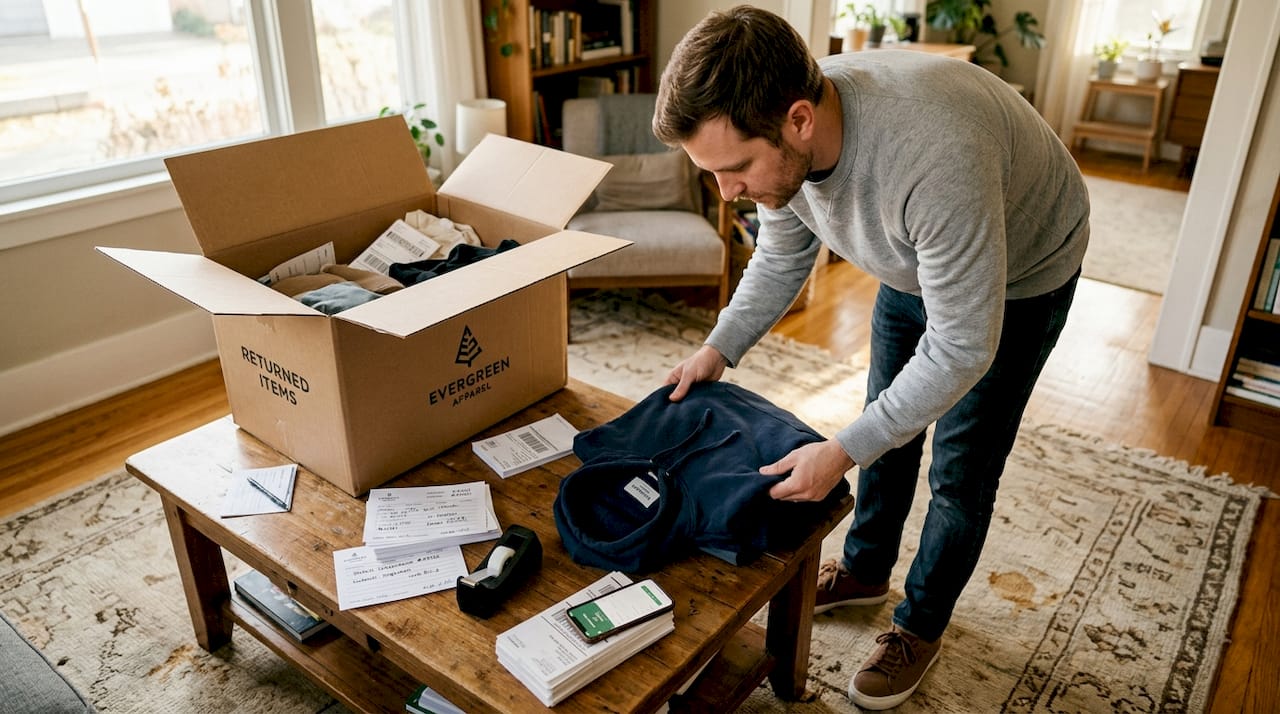
Because you don’t physically handle the garment, you need a deliberate approach to reducing mismatches between what’s promised in photos and descriptions and what actually arrives in the customer’s hands. The gap between expectation and reality is where most returns are born. Knowing how to compare apparel products from a buyer’s perspective will help you build more honest, accurate listings.
Pro Tip: When vetting suppliers, request fabric composition details, weight (in GSM for cotton), and actual garment measurements, not just standard “S/M/L” sizing. Minimalist fashion customers often have specific fit preferences, and the more data you give them upfront, the fewer returns you’ll process.
Returns, fit, and customer expectations: the hidden risks
Having identified returns and fit as priority concerns, let’s look at the real numbers and what you can do to reduce the damage.
Fashion return rates commonly run 20 to 30%, and in drop shipping that number can climb even higher because you have less control over presentation and quality consistency. Compare that to electronics (around 11%) or home goods (around 9%) and you can see why apparel is one of the harder categories to drop ship profitably.
| Category | Average return rate | Primary causes |
|---|---|---|
| Fashion/apparel | 20–30% | Fit, color, quality |
| Electronics | ~11% | Defects, compatibility |
| Home goods | ~9% | Damage, size mismatch |
| Footwear | ~25% | Fit, comfort |
The most common causes of fashion returns in drop shipping:
- Sizing inconsistency between the listing and the actual garment
- Color variation due to screen display vs. real fabric
- Quality below expectation based on product photos
- Item described inaccurately (wrong material, weight, construction)
- Shipping damage to delicate garments
Proven strategies for lowering your return rate:
- Write detailed, honest product descriptions that include fabric weight, material blend, and wash care.
- Add accurate, standardized sizing charts with body measurements, not just garment measurements.
- Use multiple photos that show the item on different body types and in natural lighting.
- Include customer reviews early, because reviews directly improve fit confidence and reduce buyer hesitation.
- Be explicit about what “regular fit” or “relaxed fit” actually means in centimeters or inches.
Using improving product content as a core operational priority, not just a marketing one, is what separates stores with 15% return rates from those dealing with 35%. Expectation management starts at the product page, long before the package ships.
Minimalist and timeless apparel like heavyweight tees, simple hoodies, and tailored pants actually benefit from this approach because the design is simple enough to photograph accurately. There are no elaborate prints, metallic finishes, or layered embellishments to confuse the camera. What you see really is what you get, as long as you photograph it properly.
What actually drives profitability in drop shipping fashion
To truly thrive with fashion drop shipping, it’s not enough to sell. You must also master the economics that matter most.
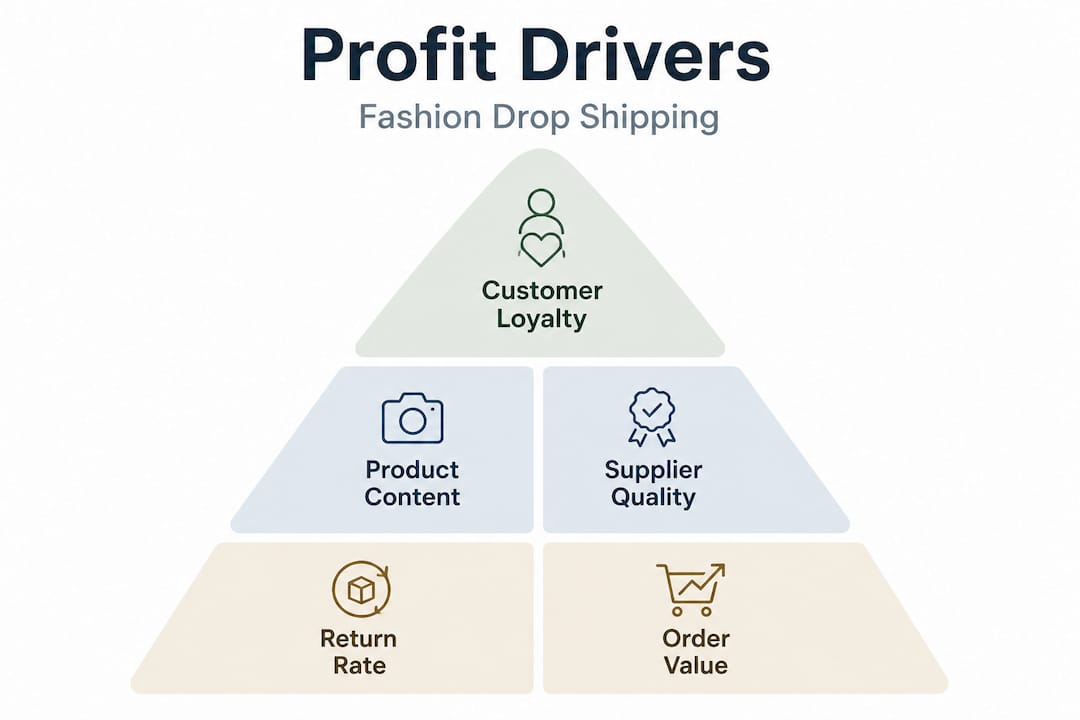
Profitability benchmarks in drop shipping differ sharply from headline gross margin expectations because shipping, advertising, platform fees, payment processing, and returns all reduce your net profit before you ever pay yourself. Many new dropshippers look at a $40 sale price and a $18 supplier cost and think they’re making $22 per order. They’re not.
Here’s what the real cost stack looks like:
- Cost of goods (COGS): The wholesale price you pay the supplier.
- Shipping cost: Either absorbed into your price or charged separately. Often $4 to $12 for apparel, more for international.
- Platform fees: Shopify, WooCommerce, or marketplace fees typically run 2 to 3% per transaction.
- Payment processing: PayPal, Stripe, and similar processors charge roughly 2.9% plus $0.30 per transaction.
- Advertising spend: Paid social, Google Shopping, or influencer costs, often $8 to $20 per acquired customer in fashion.
- Returns: Even a 20% return rate eats directly into margin, because return shipping, restocking, and lost revenue add up fast.
| Revenue and cost category | Example per order |
|---|---|
| Sale price | $42.00 |
| Supplier cost (COGS) | $16.00 |
| Shipping | $7.50 |
| Platform + payment fees | $2.80 |
| Advertising (blended) | $11.00 |
| Return provision (20% rate) | $3.20 |
| Estimated net profit | $1.50 |
That math isn’t meant to discourage you. It’s meant to calibrate your expectations. The entrepreneurs who succeed with fashion drop shipping understand their unit economics before they scale. They know that digital marketing costs must be treated as a real cost of goods, not a bonus expense. They optimize for customer lifetime value and repeat purchases, because a returning customer costs far less to acquire.
A great way to think about dropshipping economics is this: your first sale to a customer may be break-even or even slightly negative. Your second and third sales to that same customer are where real profit lives.
How to set up for success: practical steps for new fashion dropshippers
Armed with knowledge of mechanics, risks, and the true economics, let’s close with actionable, step-by-step guidance.
Think of drop shipping fashion as “retail storefront plus supplier fulfillment pipeline.” Your operational leverage lives in four places: catalog and supplier selection, accurate product and fit presentation, marketing economics, and a workable returns process.
Here’s how to build that structure from day one:
- Define your niche clearly. Timeless and minimalist apparel is a smart focus because it avoids trend-chasing and builds a recognizable brand identity. Decide on a specific customer (everyday casual wear, workwear basics, weekend comfort) before selecting products.
- Vet suppliers rigorously. Request samples. Check lead times. Verify that sizing measurements match international standards or are clearly documented. Ask about their return handling policy in writing.
- Build a clean, honest storefront. Use a reliable platform, write accurate product descriptions, and invest in quality product photography, even if that means ordering samples and shooting them yourself.
- Curate a focused catalog. Start with 8 to 12 products, not 80. Fewer products mean better quality control, more focused marketing, and cleaner customer expectations. Use apparel sizing best practices to build sizing guides that actually reduce returns.
- Prepare your marketing before launch. Know your customer acquisition cost target. Set up email capture. Plan your first 30 days of content or paid ads before you go live.
- Build your returns and customer service process. Write a clear return policy. Set up email templates for common questions. Decide upfront how you’ll handle “item not as described” claims, because they will happen.
Quick wins for minimalist apparel dropshippers:
- Use fabric GSM (grams per square meter) in descriptions, buyers searching for quality know what it means.
- Offer size guides with body measurement charts, not just garment specs.
- Collect reviews actively from the first sale onward.
- Start with domestic suppliers if possible to keep shipping times predictable and returns simpler.
Pro Tip: Start with one supplier, one product category, and one traffic source. Master the unit economics and return rates before expanding. Adding complexity before you understand your baseline is the fastest way to lose money at scale.
Starting fashion ecommerce with a focused, detail-obsessed approach is far more sustainable than launching 50 products and hoping something sticks. And to scale effectively, better product content is consistently the highest-leverage investment you can make.
The real secret to drop shipping fashion: relationships over tools
You’ve learned the steps and seen the numbers. So what actually separates the drop shipping fashion stores that survive from the ones that quietly close after six months?
It’s not the platform you choose. Shopify, WooCommerce, and every competing storefront builder offer nearly identical functionality to everyone. It’s not the automation software. Any dropshipper with a credit card can access the same tools. The real differentiators are supplier trust, responsive customer communication, and the discipline to iterate based on real data.
Your supplier relationship is your most valuable operational asset. A supplier who communicates honestly about stock levels, flags quality issues proactively, and works with you on return resolutions is worth far more than one offering a 10% lower wholesale price. The cheaper supplier who goes silent when problems arise will cost you far more in refunds, negative reviews, and lost customers.
Using reviews for quality control is one of the most underrated operational tools in this business. Reviews that mention sizing accuracy, fabric feel, and shipping experience give you live market research. They tell you exactly what your product descriptions need to say more clearly, and they build social proof that reduces return anxiety for new buyers.
Minimalist apparel is actually a perfect test case for disciplined operators. The product is simple. The photography is straightforward. The customer profile is consistent. That simplicity makes it easier to spot what’s working and fix what isn’t. If returns spike on a specific item, the cause is usually identifiable. If a sizing guide change reduces returns by 8%, you can see it clearly in your numbers. This category rewards careful, methodical operators over reactive ones.
Explore timeless drop shipping essentials with Smoked Times
Ready to put this knowledge to work and browse classic, high-quality essentials built for exactly this kind of careful, detail-oriented approach?
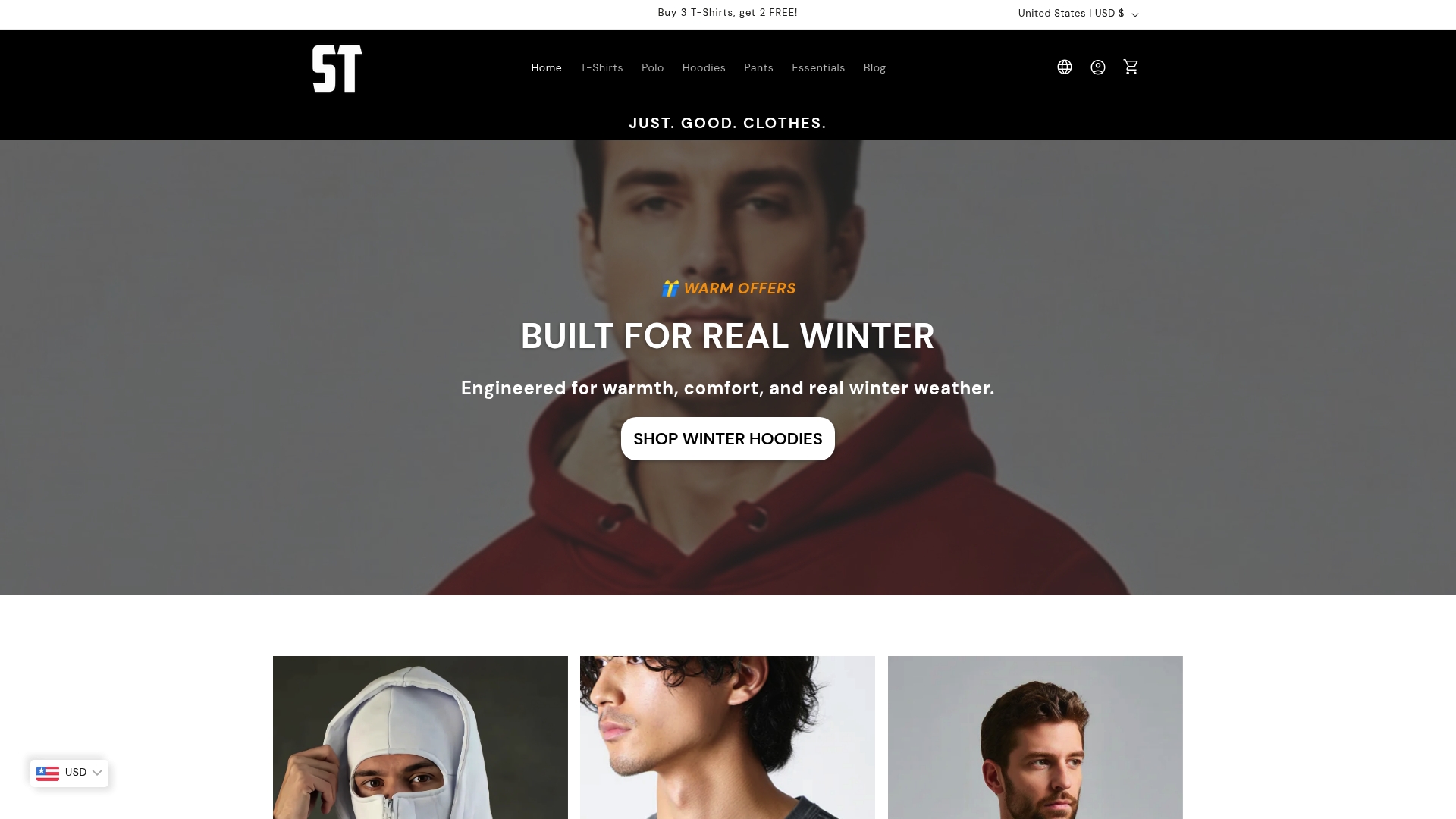
At Smoked Times, we focus on the kind of timeless, well-made basics that make sense for drop shipping: clean construction, durable fabrics, minimal branding, and consistent sizing that translates reliably across orders. Our premium minimalist hoodies are built from heavyweight cotton with a relaxed, vintage-inspired fit, the kind of piece customers order once and come back for again. Our casual timeless pants follow the same philosophy: versatile, durable, and styled for repeat wear. If you’re building a fashion drop shipping store around essentials that hold their value beyond one season, explore what Smoked Times brings to the catalog.
Frequently asked questions
Is drop shipping fashion profitable in 2026?
It can be profitable, but net margins differ sharply from gross margin expectations once you factor in returns, advertising, shipping, and platform fees. Success requires tight cost management and repeat customer focus.
How do returns work in a fashion drop shipping business?
Returns are managed according to your store policy and handled through supplier coordination, but clothing return rates run 20 to 30% due to sizing and quality mismatches, so your return process must be planned before your first sale.
What makes timeless or minimalist apparel easier or harder to drop ship?
Minimalist styles have simpler designs and more consistent sizing, which helps manage returns, but all apparel drop shipping still faces the core challenges of fit-driven returns and quality control that you can’t fully manage without handling the product yourself.
Do I need to handle customer complaints and refunds myself?
Yes. Even though you don’t ship the products, the seller’s role in dropshipping means all customer relationships, complaints, and after-sales service are your direct responsibility, regardless of what the supplier did or didn’t do.
Recommended
- Ecommerce in Apparel: Driving Global Fashion Trends – Smoked Times
- Digital Marketing in Fashion – Driving Global Trends – Smoked Times
- Global Fashion Retail Explained: Impact On Shoppers – Smoked Times
- Why Follow Fashion Trends – Real Benefits and Impacts – Smoked Times
- Why dropshipping fails: avoid common pitfalls in 2026 | EcomEye