


How to choose comfortable fabrics for everyday wear
You buy a hoodie that looks great on the rack, wear it twice, and suddenly it’s scratching your neck or trapping heat like a sauna. Uncomfortable fabric can ruin even well-designed clothes and turn daily outfits into genuine annoyances. The good news is that fabric comfort is not a mystery. There are measurable, learnable factors that separate a piece you reach for every morning from one that collects dust in the back of your closet. This guide walks you through exactly how to evaluate fabrics for both casual everyday wear and cold-weather layering, so every purchase earns its place in your rotation.
Table of Contents
- Understanding comfort in fabrics: What really matters
- Essential fabrics explained: Cotton, merino wool, fleece, synthetics
- Step-by-step: How to choose the right fabric for your needs
- Common pitfalls and troubleshooting: Comfort mistakes to avoid
- How to check your comfort choice: Testing and verification
- Experience true comfort: Explore our top comfortable fabrics
- Frequently asked questions
Key Takeaways
| Point | Details |
|---|---|
| Prioritize fiber for use | Choose merino wool or blends for varied climates and avoid cotton base layers in cold and wet. |
| Check comfort metrics | Look for GSM, fiber micron, breathability, and moisture-wicking labels when shopping. |
| Layer for best results | Combine wicking, insulating, and weather-resistant layers for maximum comfort. |
| Avoid common mistakes | Steer clear of using the wrong fabric for activity or weather to maintain consistent comfort. |
| Test and verify comfort | Always try wear, label-check, and touch-test to confirm lasting comfort in everyday clothes. |
Understanding comfort in fabrics: What really matters
With the importance of comfort established, let’s break down what actually makes a fabric comfortable. Comfort is not just about softness. It’s a combination of sensory and physical properties working together on your skin, in your environment, and across different activity levels.
The four core comfort mechanics are breathability, moisture-wicking, insulation, and softness. Fabric breathability science shows that these mechanics involve measurable values: air permeability (how freely air moves through a fabric), moisture vapor transmission rate (MVTR, how fast sweat evaporates), thermal resistance (CLO value, how well a fabric insulates), and surface texture (which determines itch and softness). Understanding these values helps you move past vague marketing claims and make real comparisons.
Building a comfortable clothing system starts with knowing why comfort matters at each layer of your outfit. A fabric that works perfectly for a summer t-shirt may be completely wrong for a winter base layer.
“Comfort mechanics involve breathability, moisture-wicking, insulation, and softness — and each plays a distinct role depending on your activity and climate.”
Key comfort criteria to evaluate before buying:
- Breathability rating (air permeability or MVTR value)
- Moisture-wicking speed and capacity
- Insulation level (CLO value for cold-weather pieces)
- Surface softness and fiber fineness (micron rating for wool)
- Weight in GSM (grams per square meter) for warmth and durability
- Fiber blend percentage (natural vs. synthetic ratio)
| Fabric | Breathability | Moisture-wicking | Insulation | Softness |
|---|---|---|---|---|
| Cotton | High | Low (slow dry) | Low | High |
| Merino wool | Medium-high | High | High | Very high |
| Fleece (synthetic) | Medium | Medium | High | High |
| Polyester blend | Medium | High | Low-medium | Medium |
Essential fabrics explained: Cotton, merino wool, fleece, synthetics
Now that you know what factors drive comfort, here’s how today’s top fabrics actually perform in real-world conditions.
Cotton is soft, breathable, and absorbs moisture but dries slowly. Merino wool wicks moisture and insulates even when wet. Fleece is lightweight and dries fast. Each has a specific role, and using the wrong one in the wrong context is where most people go wrong.

The case for 100% cotton comfort is strong for casual, warm-weather wear. It feels natural against skin, handles repeated washing well, and breathes freely in mild temperatures. The problem comes in cold or wet conditions, where cotton holds moisture against your body and loses its ability to keep you warm.
Merino wool is the standout performer for sustainable fabric types that also deliver comfort. It can absorb up to 30% of its weight in moisture while still feeling dry to the touch, which is a remarkable property for cold-weather layering. Fleece, meanwhile, is the go-to mid-layer for comfortable winter fabrics because it traps air efficiently and dries almost instantly.
When to choose each fabric type:
- Cotton: Casual summer wear, lounging, mild-weather t-shirts and polos
- Merino wool: Cold-weather base layers, travel, high-activity days in variable temps
- Fleece: Mid-layer insulation, outdoor activities, damp or windy conditions
- Polyester blends: Active wear, high-sweat situations, pieces that need to last through heavy use
| Fabric | Softness | Drying speed | Warmth | Breathability | Cost |
|---|---|---|---|---|---|
| Cotton | High | Slow | Low | High | Low |
| Merino wool | Very high | Medium | High | High | High |
| Fleece | High | Fast | High | Medium | Medium |
| Polyester blend | Medium | Very fast | Medium | Medium | Low-medium |
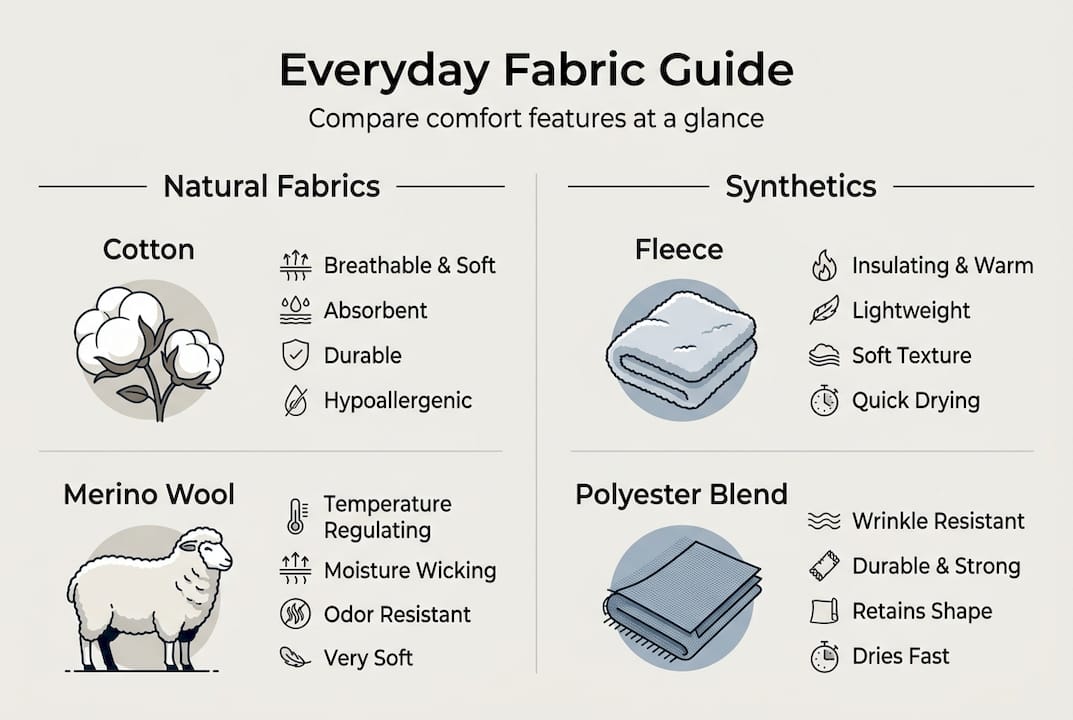
Pro Tip: When shopping for merino wool, look for a micron rating between 17 and 19. Anything above 22 microns starts to feel scratchy against bare skin. For blended synthetics, a higher polyester percentage means faster drying but slightly less breathability.
Step-by-step: How to choose the right fabric for your needs
Understanding how each fabric type works in theory is helpful, but here’s how you can put this knowledge to use the next time you shop.
Step 1: Define your primary need. Are you buying a hoodie for couch lounging, a t-shirt for outdoor errands, or a base layer for a cold hike? Your use case determines everything. Check out casual wear examples to get a clearer picture of what fits each scenario.
Step 2: Read the label carefully. Look for fiber type and blend percentage. A “cotton-poly blend” hoodie at 60% cotton and 40% polyester behaves very differently from a 90/10 split. GSM matters too: 280-320 GSM is ideal for a heavyweight hoodie, while 150-180 GSM suits a casual summer tee.
Step 3: Check comfort benchmarks. Some manufacturers list MVTR or air permeability data. When available, use it. For everyday wear, an MVTR above 5,000 g/m²/24hr signals solid breathability. For cold-weather pieces, a CLO value above 1.0 means meaningful insulation.
Step 4: Match the fabric to your layering role. Layer strategically: your base layer should wick moisture, your mid-layer should insulate, and your outer layer should block wind. The three-layer clothing system is the most reliable framework for cold-weather comfort. You can also explore layering for comfort to see how this applies to everyday styling.
Step 5: Consider climate and activity level. A fabric that works in dry cold performs differently in wet cold. Check best winter clothing fabrics for region-specific guidance.
Pro Tip: Never use cotton as a base layer in cold or wet conditions. It absorbs sweat and holds it against your skin, which drops your body temperature fast. Swap it for merino or a moisture-wicking synthetic blend.
Common pitfalls and troubleshooting: Comfort mistakes to avoid
Even with a solid process, many people trip on classic mistakes. Here’s how to avoid them.
Frequent fabric selection mistakes:
- Using cotton as a base layer in cold or wet weather
- Ignoring blend percentages on labels and assuming “cotton” means all-natural
- Buying cheap polyester for all-day wear without checking breathability ratings
- Skipping the mid-layer entirely and expecting one piece to do everything
- Choosing fabric based on appearance alone without checking GSM or fiber type
“Cotton kills” is a phrase used in outdoor communities for good reason. Avoid cotton base layers in cold or wet conditions. Merino wool outperforms because it insulates even when damp, while cotton loses nearly all insulation value once saturated.
If you’re ending up sweaty and cold, your base layer is the problem. Swap to merino or a moisture-wicking synthetic. If you’re itchy, your fabric’s micron rating is likely too high. If you’re overheating, your mid-layer is probably too heavy for the activity level. Each discomfort has a specific fix.
For layering for warmth, the goal is always to manage moisture first, then trap heat. Blends that combine merino with a small percentage of nylon add durability without sacrificing the softness that makes merino worth wearing. Browse casual comfort wear to see how these principles apply to real everyday pieces.
How to check your comfort choice: Testing and verification
Once you’ve chosen a fabric, here’s how to know if it truly delivers the comfort you need.
Practical comfort checks you can do in-store or at home:
- Touch test: Rub the fabric against the inside of your wrist. If it scratches there, it will scratch your neck.
- Crumple test: Scrunch the fabric and release. Slow recovery means it wrinkles easily and may feel stiff after washing.
- Breathability check: Hold the fabric up to light and blow gently through it. More airflow means better breathability.
- Wash test: After the first wash, check for shrinkage, pilling, or texture change. These reveal long-term comfort issues early.
- Wear test: Put it on for a full day before committing to a full wardrobe purchase. Real comfort shows up over hours, not minutes.
Empirical benchmarks help guide real-world fabric choices, including air permeability, MVTR, and RET (resistance to evaporative heat transfer) values. Lower RET means better breathability. A RET below 6 is excellent; above 20 is poor for active use.
| Fabric | Air permeability | MVTR (g/m²/24hr) | RET |
|---|---|---|---|
| Cotton | High | 3,000-5,000 | 8-12 |
| Merino wool | Medium-high | 6,000-10,000 | 4-8 |
| Fleece | Medium | 5,000-8,000 | 6-10 |
| Polyester blend | Medium | 8,000-15,000 | 3-6 |
Knowing what type of cotton is used for t-shirts also helps you set realistic expectations. Pima and combed cotton, for example, have longer fibers that produce a noticeably softer, more durable fabric than standard ring-spun cotton.
Experience true comfort: Explore our top comfortable fabrics
Now that you know how to spot true comfort, discover products that meet these standards and join a community of comfort-focused shoppers.
At Smoked Times, we build every piece around the fabric-first principles covered in this guide. Our organic cotton t-shirts use Pima cotton, one of the finest natural fibers available, delivering the softness, breathability, and durability that everyday wear demands. From heavyweight hoodies to cold-weather layering essentials, every item in our range is chosen for how it actually feels across a full day of wear, not just how it looks on a hanger.
We’d love to hear how our pieces hold up in your real-world comfort tests. If you’ve found your go-to fabric or discovered a new favorite, share your review and help other shoppers make smarter choices. Browse the full collection to find versatile, well-made options that fit every layer of your wardrobe.
Frequently asked questions
Why is merino wool considered more comfortable than regular wool?
Merino wool uses finer fibers at 17-19 microns that don’t itch and regulate body temperature more effectively than coarser standard wool. The result is a fabric that works in both warm and cold conditions without the scratchy feel most people associate with wool.
Is cotton a good fabric for winter clothing?
Cotton holds moisture and loses insulation value when wet, making it a poor choice for cold-weather base layers. It works well for casual winter outerwear in mild, dry conditions but should never sit directly against your skin in cold or wet environments.
What should I look for on a clothing label to ensure comfort?
Check for fiber type, blend percentages, and GSM and fiber types that match your use case. Terms like “moisture-wicking,” “breathable,” and specific micron ratings for wool are reliable signals of intentional comfort engineering.
How do synthetic fabrics compare to natural fabrics for comfort?
Synthetics are durable and quick-drying, making them ideal for high-activity or wet conditions, while natural fibers like cotton and merino tend to feel softer and breathe more naturally against skin. The best everyday pieces often combine both in a thoughtful blend.