


Why upcycle old apparel: creative impact for your wardrobe
TL;DR:
- Upcycling extends clothing lifespan, reducing waste, water use, and carbon emissions significantly.
- It involves creative transformation, preserving fiber quality better than recycling or reuse.
- Personal upcycling encourages cultural shifts toward slow fashion and sustainable consumption.
One small pile of old clothes can represent a surprisingly large environmental footprint. A single documented case study showed that reuse and upcycling diverted 2,311 kg of clothing from landfill, saving 327,352 liters of water and 12,002 kg of CO2 equivalent. That is not a factory-scale operation. That is what thoughtful, creative action can achieve. If you have been treating worn-out or outdated clothing as trash, this article will show you exactly why that assumption costs the planet more than you might think, and what you can do about it starting today.
Table of Contents
- What does it mean to upcycle old apparel?
- The environmental impact: Why upcycling matters
- How upcycling works: Methods, creativity, and practical tips
- Realities and challenges: What most people miss about upcycling
- A fresh take: Why upcycling is more than just eco-action
- Take your next step: Sustainable fashion options made easy
- Frequently asked questions
Key Takeaways
| Point | Details |
|---|---|
| Upcycling preserves material quality | Transforming old clothing into something new keeps fibers strong compared to recycling. |
| Significant waste and resource savings | Upcycling helps divert textiles from landfills and saves water and energy in the process. |
| Creative self-expression | Upcycled apparel is uniquely personalized and lets you showcase your values through fashion. |
| Real challenges exist | Scaling upcycling is hard and some brands may misuse the label, so authenticity matters. |
| Easy to start at home | You don’t need advanced skills—simple projects can make a meaningful difference. |
What does it mean to upcycle old apparel?
Upcycling is the practice of creatively transforming old or discarded clothing into something useful, stylish, or entirely new, without breaking the material down first. Think of a worn-out flannel shirt becoming a quilted tote bag, or a pair of jeans with a blown-out knee becoming a patchwork skirt. The item gets a second life, often with added personality and function.
This is where upcycling separates itself from its cousins, recycling and reuse. When you recycle a garment, the fibers are typically shredded, melted, or chemically broken down to produce raw material again. That process degrades fiber quality significantly. Upcycling preserves material integrity in ways that recycling simply cannot, which means the resulting product is often stronger and more durable than something made from recycled fiber. Reuse, on the other hand, means passing the item along as-is, like donating a coat or selling it secondhand. Upcycling goes further by adding new value or function to the item.
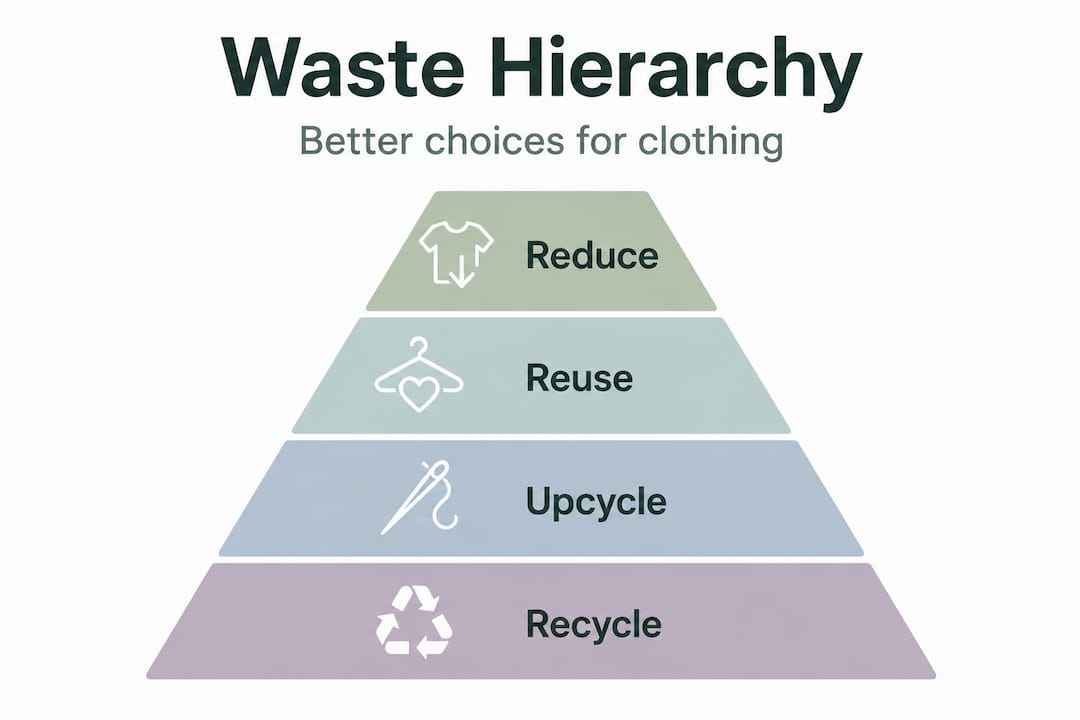
Understanding where upcycling fits in the waste hierarchy matters. The general priority order is: reduce first, then reuse, then upcycle, then recycle, and finally dispose. Upcycling sits in a powerful middle position. It keeps materials out of landfill while also keeping fiber quality high, making it one of the most resource-efficient choices you can make.
A common misconception is that upcycling just means patching a hole or sewing on a button. In reality, it can mean total transformation. A T-shirt can become a crop top, a tote, a pillow cover, or even strips of yarn for weaving. The advantages of sustainable fashion are built on exactly this kind of creative thinking.
| Approach | What it means | Fiber quality | Environmental impact |
|---|---|---|---|
| Upcycling | Transform into new item | Preserved | High positive impact |
| Recycling | Break down to raw material | Degraded | Moderate positive impact |
| Reuse | Pass along as-is | Unchanged | Positive, but limited value-add |
| Landfill | Discard | Lost entirely | Negative |
If you want to understand the full picture of sustainable fashion basics before going further, that context will make every choice you make more informed and intentional.
“Upcycling is not just a craft. It is a philosophy that asks us to see potential where others see waste.”
The environmental impact: Why upcycling matters
With a clear definition in mind, it is time to look at why upcycling is so impactful from an environmental perspective. The numbers are striking, and they go well beyond what most people expect from a home-based creative project.
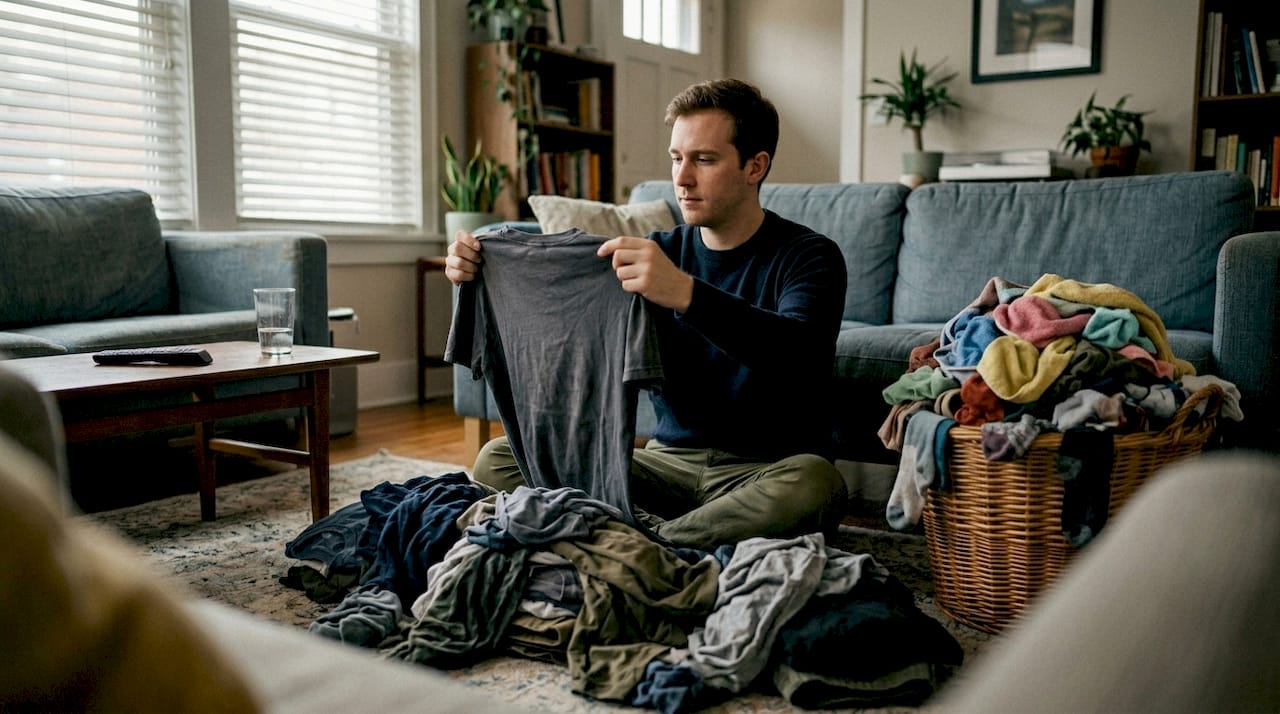
The textile industry is one of the most resource-intensive sectors on the planet. Globally, enormous volumes of clothing end up in landfill every year, where synthetic fibers can take hundreds of years to break down and natural fibers release methane as they decompose. Research confirms that recycling rates strongly correlate with textile waste reduction (r=0.713, p=0.000) and energy efficiency (r=0.624), meaning that the more we divert from landfill, the more measurable the energy and environmental savings become.
Here are the main eco-benefits of upcycling, ranked by impact:
- Landfill diversion. Every kilogram of clothing you upcycle is a kilogram that does not rot in a landfill or sit in an incinerator.
- Water conservation. Producing new clothing is extraordinarily water-intensive. A single cotton T-shirt can require over 2,700 liters of water to manufacture. Upcycling bypasses that production entirely.
- Carbon emission reduction. Avoiding new production means avoiding the energy and emissions tied to spinning, dyeing, cutting, and shipping new garments.
- Chemical pollution prevention. Textile dyeing and finishing use heavy chemicals. Upcycling old clothing skips that step entirely.
- Resource loop extension. Keeping fibers in use longer reduces demand for virgin materials, whether cotton, wool, or petroleum-based synthetics.
| Impact category | Upcycling result | Landfilling result |
|---|---|---|
| Waste diverted | Up to 2,311 kg per initiative | 0 kg diverted |
| Water saved | Up to 327,352 liters | 0 liters saved |
| CO2 avoided | Up to 12,002 kg CO2eq | Emissions from decomposition |
| Fiber quality | Maintained | Lost |
These figures come from a documented upcycling case study and represent what is achievable at a community or small-organization level. Imagine what happens when thousands of individuals make the same choice.
Pairing upcycling with other sustainable clothing practices multiplies the effect. Buying less, caring for what you own, and choosing durable materials all work together to shrink your wardrobe’s footprint. If you are building a longer-term strategy, a solid guide to a sustainable wardrobe can help you connect all the pieces. And for practical everyday steps, resources on how to reduce fashion waste offer a useful starting point.
How upcycling works: Methods, creativity, and practical tips
After exploring upcycling’s impact, many readers wonder, “How do I actually do this?” Here is how anyone can get started. Creativity is required. Sewing mastery is not.
The main upcycling methodologies include:
- Deconstruction and reconstruction. Taking a garment apart at the seams and reassembling it in a new form. A blazer can become a vest. A dress can become a skirt and a crop top.
- Patchwork. Combining scraps or panels from multiple garments into a single new piece. Great for jeans, quilts, or statement jackets.
- Dyeing. Refreshing faded clothes or completely changing their color using natural or low-impact dyes. A stained white tee becomes a tie-dye classic.
- Embroidery. Adding hand-stitched designs to plain or worn pieces. This is one of the most beginner-friendly methods and adds significant visual value.
- Applique. Attaching cut fabric shapes onto a base garment to cover damage or add decoration.
- Splicing. Combining two different garments into one, like merging two different-colored jeans into a single two-tone pair.
Easy projects you can try right now, no matter your skill level:
- Turn an old cotton T-shirt into a reusable tote bag (no sewing required, just scissors and basic knotting)
- Cut worn jeans into shorts and fray the hem for a finished look
- Transform a stained button-down into an open overshirt by removing the collar and cuffs
- Use fabric scraps to make patchwork pillow covers
- Embroider small flowers or geometric shapes over holes or stains on knitwear
Upcycling empowers eco-conscious individuals to extend clothing life creatively, reducing fast fashion’s impact while producing genuinely one-of-a-kind pieces. That last point matters more than it sounds. In a world where fast fashion produces millions of identical garments, your upcycled piece is the only one in existence.
Understanding which sustainable fabrics for upcycling work best will also help you get better results. Natural fibers like cotton, linen, and wool are easiest to work with and respond well to dyeing and embroidery. Synthetics can be trickier but are not impossible.
Pro Tip: Start with items that are still wearable but that you no longer reach for. Upcycling something you already love but want to refresh is far easier than working with a completely destroyed garment. Combine this habit with clothing repair and occasional rental for special occasions, and you cover nearly the full spectrum of circular wardrobe practices. This approach aligns directly with UNEP circular economy recommendations for maximum waste reduction.
For more eco-friendly fashion tips that complement your upcycling practice, there are plenty of accessible guides to help you build a routine that sticks.
Realities and challenges: What most people miss about upcycling
With some practical ideas in mind, it is important to understand the bigger picture and potential pitfalls in upcycling culture. Upcycling is genuinely valuable, but it is not a perfect solution to every textile problem.
The most significant challenge is labor intensity. Upcycling by hand takes time, skill, and attention. Each piece is different, which means you cannot automate the process the way a factory automates cutting and sewing. This is exactly why upcycling is hard to scale for mass production. Variable materials, inconsistent sourcing, and the need for skilled labor all create bottlenecks that industrial brands struggle to manage.
This brings us to a real risk: greenwashing. Some brands slap the word “upcycled” on products without meaningful commitment to the practice. They might use a small percentage of reclaimed material while the rest of the supply chain remains unchanged. Brands adopting upcycling must ensure authenticity to avoid greenwashing, and hybrid recycling-upcycling models tend to work best for industry-scale impact.
Here is how to spot genuinely upcycled products:
- Look for transparency about where the source materials came from
- Check for small batch or limited run production, which signals genuine handcrafting
- Ask whether each piece is truly one-of-a-kind or mass-produced with minimal variation
- Seek out brands that share photos or descriptions of the original garments used
- Prioritize makers who explain their process openly, not just their sustainability claims
Pro Tip: When evaluating a brand’s upcycling credentials, look for specific numbers and sourcing details rather than vague language like “sustainably inspired.” Authentic upcyclers are usually proud to show their work.
“The future of sustainable fashion is not one solution. It is a layered system where upcycling, repair, rental, and responsible production each play a role. No single approach carries the full weight alone.”
Understanding the broader apparel industry challenges helps put individual upcycling efforts in context. Your personal choices matter, and they also connect to larger systemic shifts happening across the industry. Knowing the sustainable apparel options available to you makes it easier to fill the gaps that upcycling alone cannot cover. For a clearer understanding of the language brands use, a solid guide to ethical fashion terminology is worth bookmarking.
A fresh take: Why upcycling is more than just eco-action
Understanding the realities, let’s zoom out to see upcycling’s deeper cultural and personal significance.
Here is something that rarely gets said in sustainability conversations: upcycling is an act of self-expression as much as it is an environmental choice. When you take a garment that was headed for the trash and turn it into something you actually want to wear, you are not just reducing waste. You are creating something that has never existed before. That is genuinely rare in a world flooded with identical fast-fashion pieces.
There is also something quietly radical about upcycling. Consumer culture is built on the idea that new is better, that last season’s clothes are already obsolete, and that the solution to a worn-out wardrobe is simply to buy more. Upcycling rejects that logic entirely. It slows everything down. It asks you to look at what you already have and ask, “What else could this be?” That question, asked often enough, starts to reshape how you think about consumption in general.
We believe the slow fashion movement is powered by exactly this kind of thinking. It is not about deprivation or going without. It is about choosing depth over volume, quality over quantity, and meaning over novelty. An upcycled jacket you made yourself carries a story that no mass-produced garment ever could.
The grassroots nature of upcycling also matters culturally. Large-scale industry solutions are important, but they take time and political will to implement. Individual creativity, shared through communities and social media, moves faster. When you show your circle what you made from an old hoodie, you normalize the idea that clothing has more than one life. That normalization is how culture shifts.
Choosing to upcycle is a small rebellion. It is quiet, practical, and wearable. And it sends a message every time you put it on.
Take your next step: Sustainable fashion options made easy
Ready to put these ideas into action? Here are a few ways to take your sustainable fashion journey further.
If you are building a wardrobe with longevity in mind, starting with well-made basics gives you more to work with over time. Pieces with durable construction and quality fabric hold up better to upcycling projects and last long enough to make the effort worthwhile.
At Smoked Times, we design clothing built for exactly that kind of long-term relationship. Our organic retro cotton t-shirts are made from heavyweight Pima cotton with minimal branding, which means they age beautifully and give you a solid canvas for dyeing, embroidery, or any upcycling project you have in mind. Durable basics are the foundation of a sustainable wardrobe, and they are worth investing in. We would also love to hear from you. If you have an upcycling story or a project you are proud of, share your upcycling story with our community and inspire others to see their old clothes differently.
Frequently asked questions
How does upcycling old apparel help the environment?
Upcycling reduces landfill waste, conserves water, and lowers carbon emissions. One initiative showed that upcycling diverted 2,311 kg of clothing from landfill while saving over 327,000 liters of water and 12,002 kg of CO2 equivalent.
Is upcycling clothing better than recycling?
In most cases, yes. Upcycling preserves fiber integrity and often adds value to the original material, while recycling typically degrades fiber quality through mechanical or chemical breakdown.
Do I need advanced sewing skills to upcycle clothing?
No. Many upcycling projects require only scissors, basic tools, and a willingness to experiment. Upcycling methods like dyeing, embroidery, and simple deconstruction are accessible to complete beginners.
How can I tell if a brand’s upcycled products are genuine?
Look for specific sourcing details, transparent production methods, and small-batch or one-of-a-kind items. Authentic upcycling brands are open about their process and avoid vague sustainability language that cannot be verified.
Why do sustainable organizations recommend upcycling before recycling?
Upcycling extends the usable life of apparel with significantly less energy and fewer resources than recycling requires. UNEP circular economy guidance recommends prioritizing upcycling of wearable items and combining it with repair and rental for the greatest overall waste reduction.
Recommended
- 7 Easy Ways to Embrace Sustainable Clothing Practices – Smoked Times
- Climate adaptive fashion: upgrade your wardrobe for weather – Smoked Times
- Role of Social Media in Apparel: Driving Fashion Trends – Smoked Times
- How collaborations transform fashion and shape timeless style – Smoked Times
- Discover the impact of upcycling in modern fashion – The Cork Store
- Bespoke: The Art of Upcycling Vintage Clothing