


Why upcycled clothing matters for sustainable everyday style
TL;DR:
- Upcycling transforms worn textiles into higher-value garments with minimal resource use and environmental impact. It reduces water, energy, and CO2 emissions significantly compared to conventional and recycled textiles, promoting unique, stylish, and durable fashion. Supporting genuine upcycled brands encourages scalable change toward a more sustainable fashion industry.
Textile recycling at just a 10% scale across the EU carries a 92% probability of cutting climate impact and a 100% probability of reducing water stress — and upcycling pushes those numbers even further by skipping the energy-heavy reprocessing stage entirely. For eco-conscious shoppers, that is not a minor footnote. It is a signal that the clothes you choose every morning carry real environmental weight. This article breaks down exactly what upcycled clothing is, how it differs from recycling and secondhand shopping, what the data says about its environmental benefits, and how you can start building a wardrobe around it without sacrificing comfort or personal style.
Table of Contents
- What is upcycled clothing — and why is it different?
- The environmental impact of upcycled clothing
- Why upcycled clothing matters for your style and values
- How to add upcycled clothing to your wardrobe
- The uncomfortable truth: Upcycled fashion is not a silver bullet — but it is worth embracing
- Ready to try upcycled style? Shop sustainably with Smoked Times
- Frequently asked questions
Key Takeaways
| Point | Details |
|---|---|
| Upcycling reduces impact | Choosing upcycled clothing can cut emissions and resources use by over 90 percent compared to conventional fashion. |
| Unique style benefits | Upcycled pieces offer one-of-a-kind designs that let you express your values and stand out comfortably. |
| Supports sustainable innovation | Demand for upcycled fashion drives brands to create more value from waste, sparking change in the industry. |
| Practical for eco-conscious living | Adding upcycled pieces to your wardrobe is a tangible way to align your shopping with environmental values. |
What is upcycled clothing — and why is it different?
Upcycling is the practice of taking worn, discarded, or surplus textiles and creatively transforming them into something with equal or greater value. No shredding, no chemical baths, no industrial pulping. A pair of selvedge denim jeans becomes a structured tote. A stack of vintage flannel shirts becomes a patchwork hoodie. The original material holds its integrity, and the new garment often holds more character than anything made from scratch.
This is fundamentally different from what most people picture when they hear “recycling.” Traditional textile recycling breaks fibers down mechanically, chemically, or enzymatically to create new raw material — a process that, while valuable, still consumes energy and water. Research confirms that upcycling into functional fibers via these methods enables value-added sustainable products, but the upcycling step that precedes breakdown is where the highest resource savings live. You are working with the material as it already exists, not converting it back to zero.
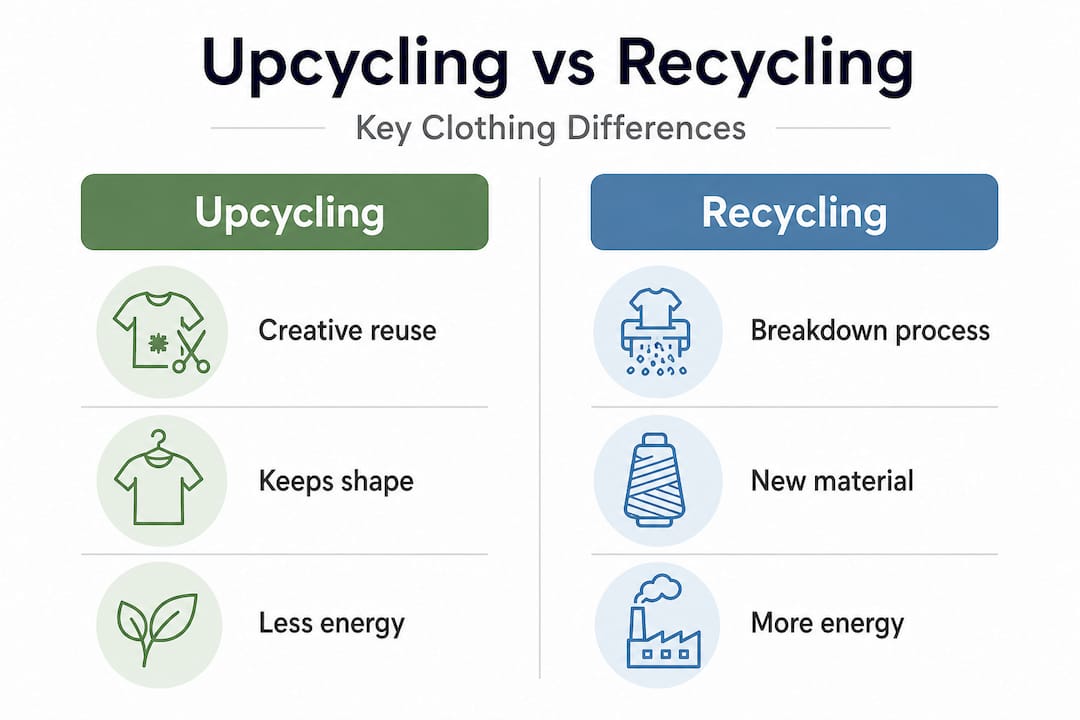
Resale and secondhand shopping are related but distinct. Buying a used flannel shirt at a thrift store keeps it in circulation, which is great. But upcycling actively redesigns and elevates that shirt into something new, extending its useful life by years or even decades while adding creative value. Our fashion resale guide covers the secondhand side of the equation in depth if you want to compare both approaches.
Upcycling vs. other sustainable options: a quick comparison
| Method | Resource use | New material needed | Unique output | Waste diverted |
|---|---|---|---|---|
| Upcycling | Very low | None | Yes | High |
| Textile recycling | Moderate | Partial | No | High |
| Secondhand resale | Minimal | None | No | Moderate |
| Conventional new | Very high | 100% | No | None |
Here is what makes upcycled pieces genuinely stand out for everyday wear:
- One-of-a-kind design: Because each piece starts from existing material, no two items are identical.
- Embedded history: The fabric carries texture, fading, and character you simply cannot replicate with virgin material.
- Lower resource footprint from day one: No cotton farming, no dyeing vats, no spinning mills required.
- Innovation-driven construction: Makers must be inventive with what they have, which often produces more thoughtful, better-constructed garments.
If you are still building your vocabulary around this space, our guide to eco-friendly clothing explained is a good parallel read.
The environmental impact of upcycled clothing
Numbers matter here because sustainability claims without data are just marketing. So let us look at what the research actually says.
A 2026 circular economy study compared the environmental costs of virgin wool, recycled wool, and unraveled (upcycled) wool jumpers. The results are striking. Recycled wool carries eco-costs of just 0.31 EUR and 1.56 kg of CO2 equivalent per garment, compared to 3.53 EUR and 21.93 kg CO2 equivalent for virgin wool. Unraveled wool, the upcycled option, comes in even lower at roughly 0.19 EUR eco-costs and 0.89 kg CO2 equivalent. That is a reduction of more than 90% compared to buying new.
Environmental impact by wool garment type
| Garment type | Eco-costs (EUR) | CO2 equivalent (kg) |
|---|---|---|
| Virgin wool jumper | 3.53 | 21.93 |
| Recycled wool jumper | 0.31 | 1.56 |
| Upcycled (unraveled) wool jumper | 0.19 | 0.89 |
Water use tells an equally important story. Scaling textile recycling to 10% in the EU produces a 100% probability of reducing water deprivation by more than 3%, and upcycling avoids the water-intensive reprocessing step entirely. For context, producing a single conventional cotton t-shirt uses roughly 2,700 liters of water. Upcycling a garment instead of manufacturing one from new cotton eliminates that water demand almost completely.
These are not marginal gains. They represent a meaningful shift in your wardrobe’s environmental footprint, and they compound over time as more pieces in your closet come from upcycled sources.
To understand how different materials stack up in general, our roundup of sustainable fabrics examples gives you a broader material-level view. And if you want the bigger picture on why fashion’s environmental footprint is so significant, our piece on why sustainable fashion matters adds important context.
Pro Tip: If you are shopping for upcycled pieces, prioritize small-batch producers. Larger commercial operations often dilute their upcycling claims by mixing in a small percentage of upcycled material with virgin fiber. Small-batch makers who source locally tend to produce more genuinely upcycled garments and are more transparent about their process.
Why upcycled clothing matters for your style and values
There is a persistent myth that sustainable clothing means compromise: muted colors, rough textures, shapeless cuts. Upcycled fashion actively disproves this idea. Because makers start with existing materials that already carry texture, fade, and character, the resulting pieces often have far more visual personality than anything freshly manufactured.
As NC State’s textile research hub notes, upcycling offers stylish unique everyday wear by creatively repurposing waste into comfortable, higher-value garments that reduce landfill waste and resource use while fostering innovation. That last point matters: when designers work within constraints, they tend to produce more creative solutions. Scarcity drives inventiveness in ways that unlimited material budgets simply do not.
For you as a consumer, upcycled clothing does something clothing has always done at its best — it communicates identity. Wearing a piece made from reclaimed material is a quiet but clear signal about what you value. It says you care about resource use, about craftsmanship, about circular thinking. That is not performative. It is a genuine alignment between your daily choices and your broader values.
Here is why eco-conscious shoppers are gravitating toward upcycled pieces for everyday wear:
- Wearability: Repurposed fabrics like vintage cotton and reclaimed denim are often already broken in, meaning they are soft, flexible, and immediately comfortable.
- Rarity: You will not see a dozen people wearing the same thing. Your upcycled jacket or hoodie is genuinely yours.
- Craftsmanship: Small-batch upcycled makers typically put more hands-on attention into each piece than a factory assembly line.
- Conversation: These pieces have stories attached. People ask about them.
- Values alignment: Supporting upcycled brands directly encourages the industry to invest more in circular production models.
“Fashion that repurposes rather than discards is not a trend. It is a direction. When consumers ask for it consistently, the whole industry follows.” — NC State College of Textiles, 2026
Explore sustainable apparel options for more guidance on building a wardrobe that reflects both practicality and purpose. And if you want to take action now without overhauling everything at once, our list of easy ways to embrace sustainable clothing gives you a low-friction starting point.
How to add upcycled clothing to your wardrobe
You do not have to rebuild your closet overnight. The most effective shift toward upcycled clothing happens gradually, one intentional piece at a time. Here is a practical sequence that works well for most shoppers.
-
Audit what you already own. Before buying anything new or upcycled, identify which garments you actually wear and which have been sitting untouched for six months or more. This gives you a clear picture of the gaps you actually need to fill.
-
Find reputable upcycled sources. Look for local makers at craft fairs and maker markets, independent online brands with clear production transparency, and vintage shops that do in-house redesign. National brands are beginning to add upcycled lines too, though the quality and authenticity vary significantly.
-
Evaluate construction quality carefully. Upcycled does not automatically mean durable. Check seams, stitching density, and how panels are joined. A well-made upcycled hoodie from reclaimed cotton should feel as sturdy as any quality conventional piece.
-
Prioritize comfort fabrics. Reclaimed wool, vintage cotton, and pre-worn denim tend to be the most comfortable upcycled materials because they have already gone through the softening process that new fabric takes years of washing to achieve.
-
Care for your pieces to maximize longevity. Cold water washing, air drying, and gentle detergents extend the life of upcycled garments significantly. Many upcycled pieces use natural fiber dyes or original colorways that hold better with careful washing.
-
Think in terms of cost-per-wear. Upcycled pieces are sometimes priced higher than fast fashion because they require more skilled labor. But when you calculate the price against how many times you will wear a quality piece, the math almost always favors the investment.
-
Ask brands direct questions. A brand committed to genuine upcycling will be able to tell you exactly where their source materials come from, how they are assessed for quality, and what percentage of each garment is reclaimed. If the answers are vague, that is informative.
Research from NC State confirms that eco-conscious consumers gain stylish unique wear through upcycling, but the gains are maximized when buyers engage actively with what they purchase rather than treating it as a passive label. For a broader framework on what to look for in sustainable essentials, our guide to eco-friendly basics is a helpful companion resource.
Pro Tip: Ask brands whether their upcycled pieces are produced in-house or outsourced to a third-party manufacturer. In-house production almost always means tighter quality control and more authentic sourcing. Outsourced upcycling can still be legitimate, but it requires more verification on your part.
The uncomfortable truth: Upcycled fashion is not a silver bullet — but it is worth embracing
Let us be direct about something the sustainable fashion space often dances around. Upcycling at the scale of the global apparel industry is not currently possible. The supply of quality waste textiles is inconsistent, varies by region, and does not map neatly onto the volume demanded by major retail chains. Small brands can build genuine upcycled lines. Large ones struggle to maintain sourcing integrity at scale without diluting what “upcycled” actually means.
This matters because greenwashing is a real and growing problem. Some brands market themselves as upcycled while relying on a small percentage of reclaimed material in otherwise conventionally produced lines. The label gets applied where it does not fully belong, which erodes consumer trust and muddies the actual environmental benefit.
But here is where we land, honestly: none of that cancels out the value of individual choices. When you buy from a small-batch maker who genuinely upcycles, you are funding a production model that the industry needs more of. Consumer demand shapes what gets funded, what gets scaled, and what becomes mainstream. The history of organic cotton, of fair trade certification, of plant-based materials in footwear — all of it started with a niche group of buyers choosing differently before the rest of the market caught up.
The global fashion retail impact of even modest consumer shifts has been documented repeatedly. Buying mindfully in smaller quantities, choosing durable over disposable, and supporting transparent producers sends a signal that compounds. Upcycling is not a complete fix. But it is a real, measurable, and meaningful part of a better direction for how we clothe ourselves.
Ready to try upcycled style? Shop sustainably with Smoked Times
Understanding upcycled fashion is one thing. Finding pieces that hold up in real, everyday life is another. At Smoked Times, we build our basics around the same principles that make upcycled fashion worth caring about: durable materials, minimal branding, and construction designed for the long haul.
Our retro cotton t-shirt in organic Pima cotton is a great example of where sustainable material choice meets genuine comfort. Organic Pima cotton uses significantly less water and no synthetic pesticides, and the heavyweight feel means fewer replacements over time. If you are ready to build a wardrobe grounded in sustainability and style, explore all our styles and find essentials that align with the values you just read about. Sustainable fashion does not have to be complicated or compromise on comfort.
Frequently asked questions
What makes upcycled clothing more eco-friendly than recycled clothing?
Upcycled clothing transforms existing garments into higher-value products without the energy-intensive breakdown that recycling requires, saving significantly more resources by avoiding extra processing steps entirely.
How much can upcycled clothing reduce my wardrobe’s environmental impact?
Switching to upcycled garments like wool jumpers can cut emissions and eco-costs by more than 90%, with upcycled wool generating just 0.19 EUR in eco-costs and 0.89 kg CO2 equivalent versus 3.53 EUR and 21.93 kg for virgin wool.
Does upcycled fashion mean sacrificing comfort or style?
Not at all. Repurposed fabrics are often already softened from prior wear, and the creative constraints of upcycling push makers toward more inventive, genuinely stylish designs that stand apart from conventional production.
How do I verify a brand’s upcycled clothing claims?
Ask brands directly where their source materials come from and what percentage of each garment is reclaimed. Authentic upcycled lines are typically small-batch and fully transparent about their production process, while vague or overly broad answers are a sign to look closer.