


Why practical clothing matters for your wardrobe
TL;DR:
- Practical, well-made clothing staples often outperform fast fashion in cost, longevity, and environmental impact.
- They reduce waste and save money by emphasizing versatile, timeless pieces with low cost-per-wear.
Most people assume that a bigger, trend-forward wardrobe signals better style. The opposite is often true. Practical, well-made clothing staples quietly outperform fast fashion in every metric that matters: cost, longevity, comfort, and environmental impact. The idea that variety equals value is one of the most expensive misconceptions in everyday dressing. This article breaks down exactly why practical clothing is a smarter choice, backed by real numbers and clear frameworks. You’ll walk away knowing how to evaluate, select, and care for the pieces that will serve you best season after season.
Table of Contents
- The true cost of impractical vs. practical clothing
- Why practicality means sustainability and less waste
- How to spot practical clothing that works for you
- Making practical clothing last: Care, rotation, and mindset shifts
- A practical wardrobe is freedom, not limitation
- Ready to upgrade? Find your next practical wardrobe staple
- Frequently asked questions
Key Takeaways
| Point | Details |
|---|---|
| Cost-per-wear wins | Practical clothing saves money in the long run by maximizing use and minimizing frequent replacements. |
| Less waste, more impact | Choosing versatile staples means fewer discarded items and a healthier planet. |
| Easy to identify | Look for comfortable, timeless, and durable pieces adaptable to your lifestyle. |
| Simplicity brings freedom | A practical wardrobe reduces decision fatigue and lets your style stand out through basics. |
The true cost of impractical vs. practical clothing
Now that we’ve set the stage for rethinking the value of your wardrobe, let’s dig into exactly how practical pieces outperform their trendier counterparts.
The single most useful framework for evaluating clothing is cost-per-wear (CPW). The math is straightforward: divide the purchase price by the number of times you actually wear the garment. CPW analysis consistently shows that quality practical pieces deliver far lower long-term costs than cheap, trend-driven alternatives. This one formula changes everything about how you shop.
Here’s a real-world comparison that illustrates the gap clearly:
| Item | Purchase price | Wears per year | Years owned | Total wears | CPW |
|---|---|---|---|---|---|
| Quality suit (practical, classic cut) | $550 | 48 | 10 | 480 | $1.15 |
| Fast fashion suit (replaced 4x) | $700 total | 48 | 10 | 480 | $1.46 |
| Premium suit (bespoke, classic) | $3,000 | 48 | 10 | 480 | $6.25 |
| Trendy statement blazer | $180 | 8 | 2 | 16 | $11.25 |
The trendy statement blazer looks affordable at $180, but at only 8 wears per year over two seasons, its CPW reaches $11.25. Compare that to a $550 well-built, classic-cut suit worn regularly over a decade, and you’re spending less per use while building a more coherent wardrobe.
What drives impractical purchases in the first place? A few common patterns show up again and again:
- Trend-chasing: Buying something because it’s popular right now, not because it fits your real life
- Single-use occasions: Purchasing pieces for one event and never wearing them again
- Poor fit: Clothes that are almost right but never comfortable enough to wear often
- Impulse buying: Grabbing something on sale without thinking about how it works with existing pieces
- Seasonal gimmicks: Novelty items that feel fresh for one month and dated the next
Pro Tip: Before buying anything in a fitting room, do a simple arm raise and a shallow squat. If the garment pulls, bunches, or shifts uncomfortably, it won’t get worn regularly, and your CPW will suffer.
The best investments you can make are smart seasonal shopping decisions centered on comfortable, classic pieces that translate across seasons. A heavyweight cotton tee, a well-fitted pair of chinos, or a clean hoodie in a neutral tone will always outperform that embellished jacket you wore three times in 2024.

Why practicality means sustainability and less waste
Beyond saving money, practical clothing choices play a crucial role in living more sustainably and cutting down on waste.
“The average American discards 70 pounds of clothing every single year.”
That number is staggering when you sit with it. Seventy pounds of fabric, dye, labor, and water, heading to a landfill or incinerator. Much of that waste comes directly from purchasing clothes that don’t serve a real, repeatable purpose in your life.
Here’s how the numbers compare between two different purchasing approaches over a single year:
| Category | Trend-driven shopper | Practical staples shopper |
|---|---|---|
| Items purchased per year | 45 | 12 |
| Items replaced within 1 year | 20 | 2 |
| Items discarded within 2 years | 32 | 3 |
| Average garment lifespan | 1.5 years | 6+ years |
| Estimated annual clothing spend | $1,800 | $620 |
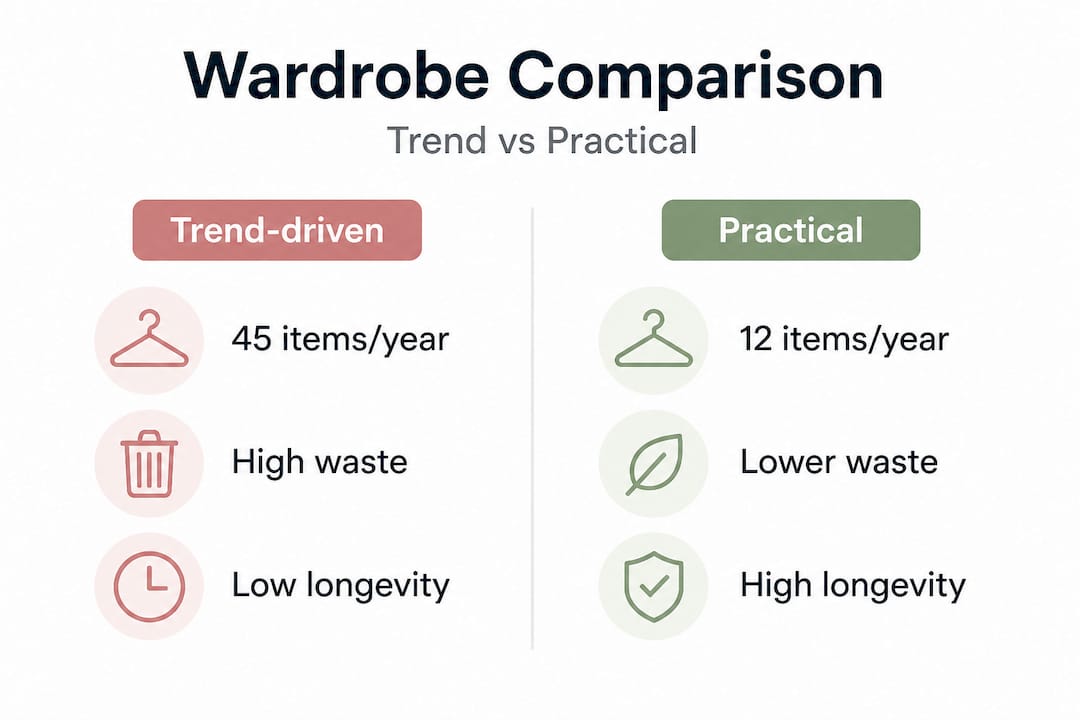
The practical shopper buys fewer items, replaces them rarely, and discards almost nothing within two years. The environmental math follows the same logic. Fewer garments purchased means less manufacturing energy, less water used in cotton or synthetic production, and fewer items ending up in textile waste streams.
Versatile staples make this possible for a few specific reasons:
- Neutral colors and classic silhouettes stay relevant without seasonal updates
- Durable fabrics like heavyweight cotton hold up through hundreds of washes without breaking down
- Quality construction means seams don’t split, colors don’t fade, and fits don’t distort over time
- Fewer items overall means more intentional care and attention for each piece
You can explore simple sustainable practices to add to your routine, including washing habits and fabric choices that reduce your impact without requiring a complete wardrobe overhaul. Understanding sustainable fabric examples also helps you make better decisions at the point of purchase.
It’s also worth reading up on eco-friendly clothing explained to understand how material sourcing, manufacturing, and end-of-life disposal all connect to the choices you make when you buy a new piece of clothing.
How to spot practical clothing that works for you
You now know the value and impact of practical clothing. Here’s how you can actually find and select these pieces for your own wardrobe.
Not all “basics” are created equal. The word gets used loosely in fashion marketing, but a genuine wardrobe staple earns its place through specific qualities. Here’s a simple numbered process to evaluate any garment before you buy:
- Evaluate comfort and fit. A garment that doesn’t feel natural won’t get worn. The fit should allow full movement without restriction, and the fabric should feel good against your skin after extended wear.
- Consider versatility. Ask yourself: can this piece work in at least three different outfits? Can it be dressed up for a casual meeting and worn down for a weekend errand? If the answer is no, it’s probably not a true staple.
- Check material durability. Look at fabric weight, weave density, and stitching quality. Heavyweight cotton, for example, offers substantially better durability than light, open-weave fabrics. Pull at the seams gently. Check the hem.
- Look for timeless styles. Classic cuts don’t expire. A straight-leg pant, a crew-neck tee, or a zip-up hoodie in a neutral color will remain wearable for years without looking dated.
- Apply the CPW framework. Before committing, estimate realistically how many times you’ll wear this item per year. Multiply that by how many years you expect it to last. Divide the price. If the CPW number feels uncomfortable, that’s useful information.
Pro Tip: When trying on clothes in a store or thinking through an online purchase, mentally run through your actual week. Would you wear this on Monday? What about Thursday? If you can only imagine wearing it once in a while, you’re looking at a low-wear item that will drain your CPW.
The CPW formula combined with physical fit tests like arm raises and squats helps you prioritize longevity, savings, and sustainability all at once. It’s a simple habit that pays off over years of smarter shopping.
For deeper guidance on building an intentional wardrobe, the sustainable clothing guide and the ethical apparel guide both offer practical frameworks for thinking beyond the purchase moment.
Your wardrobe doesn’t need to be large. It needs to be right. A black tee that fits perfectly, a pair of well-made jeans that move with you, and a neutral hoodie you actually want to reach for every morning. Those three items, worn consistently and cared for properly, will outperform a closet full of regrettable purchases every single time.
Making practical clothing last: Care, rotation, and mindset shifts
To get the most out of a practical wardrobe, you’ll want to adopt some simple care habits and a fresh perspective on what ownership means.
Even the best-made garment will deteriorate quickly with poor care. The lifespan of your clothing is directly tied to how you wash, dry, store, and use it. These habits aren’t complicated, but they require a small shift in how you think about your clothes.
Key habits that extend garment life:
- Wash in cold water. Hot water breaks down fabric fibers faster, causes colors to fade, and shrinks natural materials. Cold water handles most everyday dirt effectively without the damage.
- Air dry when possible. The tumble dryer is one of the biggest causes of premature fabric wear. Air drying preserves shape, weight, and color far better over time.
- Repair small damages early. A loose thread, a small hole, or a worn-down cuff doesn’t have to mean the end of a garment. Small repairs extend a piece’s life by years.
- Rotate items by season. Wearing the same five items on repeat without rotation creates uneven wear. Rotating thoughtfully spreads the use across your wardrobe and helps each piece last longer.
- Follow care labels. This sounds obvious, but most people ignore care instructions. Following them consistently makes a measurable difference in garment longevity.
Pro Tip: Store out-of-season garments in breathable cotton bags or folded neatly in a dry drawer. Avoid plastic bags, which trap moisture and can cause mildew or fabric breakdown over time.
The mindset piece is just as important as the practical habits. When you treat your clothes as investments rather than disposable items, you interact with them differently. You handle them more carefully, clean them more thoughtfully, and make better decisions about what you bring into your wardrobe in the first place.
Periodic wardrobe audits, reviewing what you own every six months, help you identify pieces that are underused, damaged, or no longer serving your life. Rather than discarding these, consider repairs, donations, or exploring a fashion resale guide to give them a second life with someone who will actually wear them.
The evidence is clear that versatile staples extend wear and reduce the kind of casual discarding that contributes to the 70-pound annual waste problem. It doesn’t take a radical lifestyle change. It takes a few deliberate habits applied consistently.
A practical wardrobe is freedom, not limitation
After walking through the strategies and data, it’s worth stepping back to address something bigger: the fear that a practical wardrobe means giving up your sense of style.
This is the most persistent myth in the whole conversation. People worry that simplifying means looking boring, blending in, or losing some form of self-expression. In reality, it creates the opposite effect. When you’re not buried under decision fatigue from a stuffed, chaotic closet, you dress with more confidence and intention.
Think about it this way. A closet with 12 pieces you genuinely love and reach for constantly delivers far more daily satisfaction than 60 items you feel lukewarm about. Every morning becomes easier. You stop second-guessing yourself. You spend less mental energy on what to wear and more on what you actually want to do that day.
There’s real data supporting this. Studies on why sustainable fashion matters repeatedly surface the same finding: people who simplify their wardrobes report higher satisfaction with their daily style, not lower. The limitation was never the small wardrobe. It was the noise of too many options.
We’d challenge you to try a single month with a capsule approach: 10 to 15 pieces, nothing else. Pick the items you actually love and trust. See how it feels to get dressed without friction. Most people who try this don’t want to go back.
The “more is better” idea is a retail narrative, not a lifestyle truth. Practicality isn’t about austerity. It’s about building a wardrobe that works for you so efficiently and quietly that you stop thinking about it as a problem to solve. That’s the real freedom.
Ready to upgrade? Find your next practical wardrobe staple
Inspired to make a change? Here’s how to put practicality into practice, starting with your very next clothing purchase.
At Smoked Times, we build everything around the idea that great basics shouldn’t require compromise. Our premium hoodies are designed for everyday wear: heavyweight, clean, minimal branding, and cut for real comfort across all seasons. These are the kinds of pieces that earn a permanent spot in your rotation because they genuinely deliver every time you reach for them.
Right now, we’re offering an exclusive hoodie bundle offer that makes it even easier to start building with quality. Whether you’re refreshing your wardrobe from scratch or just adding one reliable piece, this is the kind of investment that pays off every single wear. Practical shopping starts here, with one timeless piece chosen deliberately.
Frequently asked questions
What is cost-per-wear and why does it matter?
Cost-per-wear divides a garment’s price by the number of times you wear it, revealing the true value of practical clothing compared to cheaper but less-worn alternatives.
How does practical clothing help the environment?
Practical clothing lasts longer and gets worn more often, which directly reduces textile waste and shrinks your overall environmental footprint from manufacturing and disposal.
What makes clothing “practical”?
Practical clothing features comfortable fits, timeless designs, durable materials, and enough versatility to work across multiple occasions, making it worth wearing again and again.
How do I start building a more practical wardrobe?
Start by assessing your actual daily needs, choosing neutral mix-and-match basics, and applying the CPW framework during every future purchase to prioritize longevity over impulse.
Recommended
- Fashion layering: minimalist, comfortable, versatile style – Smoked Times
- Climate adaptive fashion: upgrade your wardrobe for weather – Smoked Times
- Why layer clothing for better warmth and style – Smoked Times
- Best outdoor clothing essentials for winter comfort – Smoked Times
- Master Winter Formalwear Layering: Stay Warm & Stylish - DressMeUpNY
- Eco-conscious maternity wear: Stylish, sustainable, comfortable